

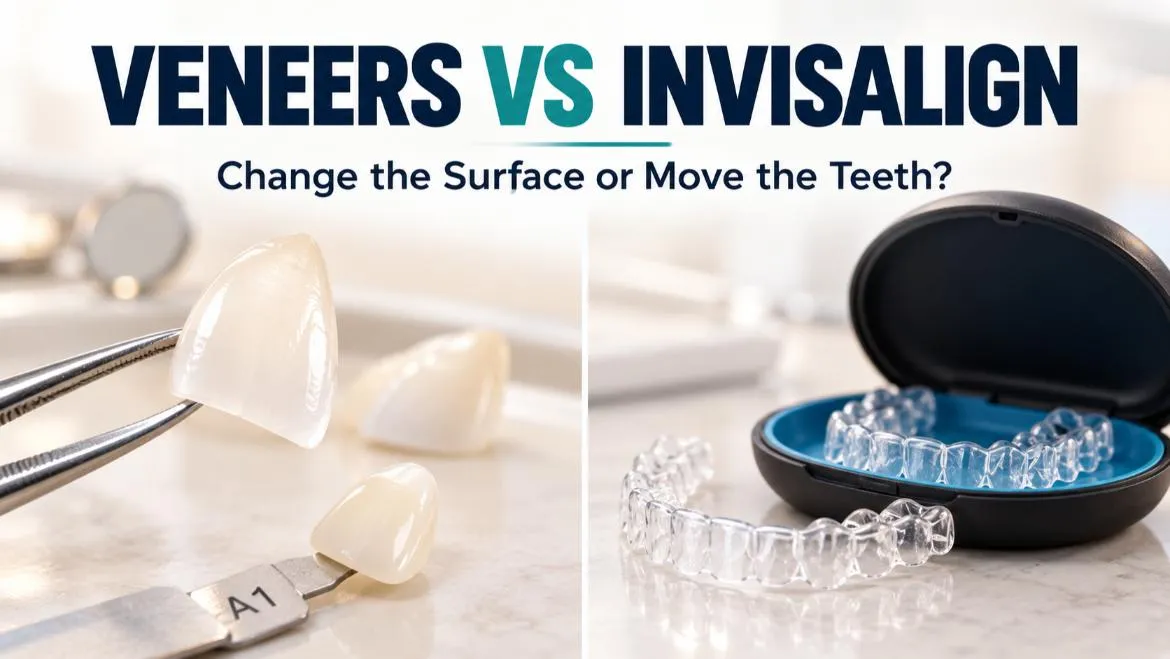
The simplest way to understand veneers vs Invisalign is this: veneers change the visible surface of teeth, while Invisalign moves teeth into new positions. Veneers may improve color, shape, size, and minor visual irregularities. Invisalign may address crowding, spacing, and certain bite concerns. The right option depends on what is causing the part of your smile you want to change.
Table of Contents
These are not interchangeable treatments. A chipped tooth may need a different solution from a healthy tooth that sits out of line. Sometimes orthodontic treatment comes first and limited cosmetic work follows.
This guide offers general educational information, not a diagnosis. A dentist or orthodontist needs to examine your teeth, gums, enamel, roots, and bite before recommending treatment.
Veneers vs Invisalign at a Glance
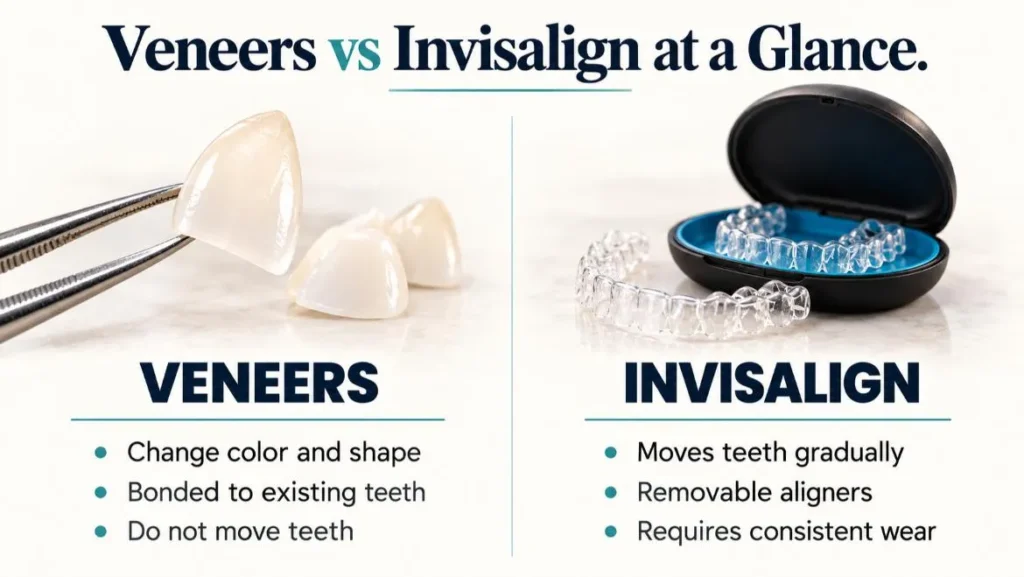
When comparing veneers vs Invisalign, start with your goal. If you mainly dislike tooth color, proportions, worn edges, or small chips, veneers may be discussed. If the concern is where the teeth sit or how they meet, Invisalign may be the more relevant conversation.
| Factor | Veneers | Invisalign |
| Main purpose | Changes the visible surface, shape, color, or proportion of selected teeth | Gradually moves teeth and may improve alignment or certain bite problems |
| Treatment type | Cosmetic or restorative dental treatment | Orthodontic treatment |
| What is placed | Bonded porcelain or composite material | A planned series of removable clear aligners; attachments may also be used |
| Tooth removal | Porcelain veneers commonly require some enamel preparation; the amount varies | Does not cover teeth, although minor enamel reshaping between teeth may sometimes be planned |
| Daily routine | Fixed in place; clean like natural teeth with careful brushing and interdental cleaning | Usually worn about 20–22 hours daily and removed for meals, drinks other than water, and cleaning |
| Color change | Can mask discoloration within the treated area | Does not whiten or cover tooth color |
| After treatment | Ongoing dental care; a damaged veneer may need repair or replacement | Retainers are normally needed to help maintain the new positions |
| Best question | “Do I want to change how these teeth look?” | “Do I need to change where these teeth are?” |
What Veneers Actually Change
Dental veneers are thin restorations bonded to the front-facing surfaces of teeth. They may alter color, contour, length, symmetry, or the appearance of small gaps. The American Dental Association’s veneer overview explains that veneers are shells made from tooth-colored materials and that enamel removal may be required before placement.
Porcelain and composite veneers
Porcelain veneers are made outside the mouth and bonded later. They can offer lifelike translucency and stain resistance, but repair or replacement can be involved. Direct composite veneers are sculpted on the tooth and may be completed more quickly; they are often easier to repair but can stain or wear sooner.
The choice between those materials is separate from veneers vs Invisalign. Someone with well-aligned teeth and one chipped edge may be better served by conservative bonding than a full set of porcelain veneers. Our detailed bonding vs veneers comparison explains where those treatments overlap and where they differ.
What veneers do not do
Veneers can make a mildly rotated or uneven tooth look straighter from the front, but they do not move the tooth, root, or supporting bone. They also do not treat active decay, gum disease, tooth mobility, or an unhealthy bite. Covering a problem without identifying its cause may produce a result that looks attractive at first but is difficult to maintain.
This is why veneers vs Invisalign should not be reduced to which gives the fastest visual change. A cosmetic shortcut is not automatically the healthiest plan.
How Invisalign Moves Teeth
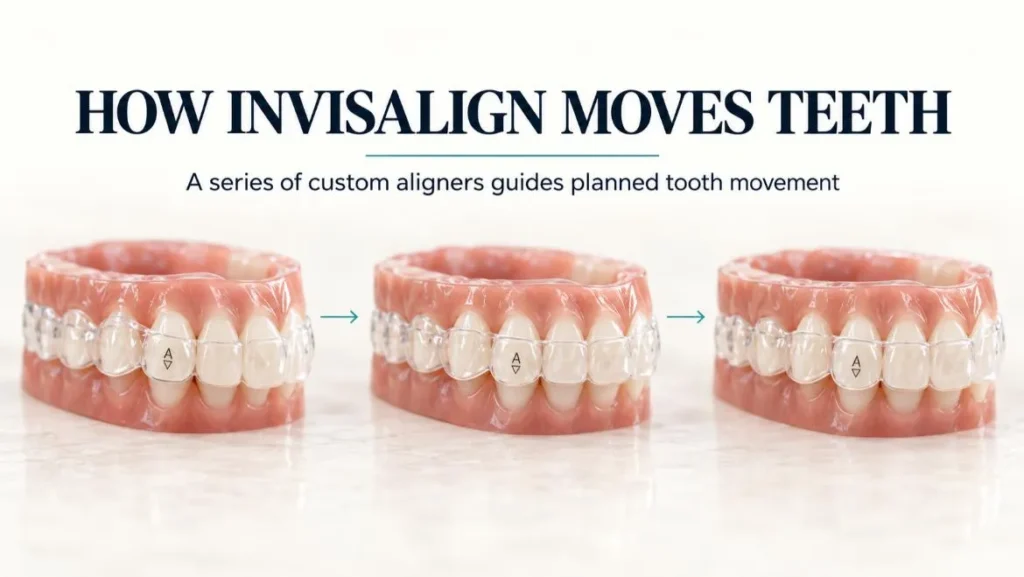
Invisalign is a brand of clear-aligner orthodontic treatment. A dentist or orthodontist records the teeth, plans a series of movements, and provides sequential custom aligners. Each aligner applies controlled pressure so teeth move gradually rather than being visually covered.
The official Invisalign treatment guide describes a doctor-directed process using custom clear aligners. Professional diagnosis matters because unsupervised treatment may miss gum, root, bone, or bite problems that are not obvious in a mirror.
Aligners, attachments, and wear time
Many Invisalign plans use small tooth-colored attachments that give the trays additional grip. Some cases may also involve elastics or limited reshaping between teeth to create space. Patients commonly need to wear their aligners for approximately 20–22 hours per day, changing them according to their clinician’s instructions.
The American Association of Orthodontists’ clear-aligner guidance notes that aligners are removed for eating, drinking, brushing, and flossing. Inconsistent wear can delay progress or prevent planned movements from tracking correctly.
Retainers after treatment
Teeth can shift after orthodontic treatment. Retainers are therefore a normal part of the Invisalign journey, not an optional extra to consider only if movement returns. Your clinician will specify the retainer type and wear schedule.
In practical terms, veneers vs Invisalign involves different commitments: long-term restoration care versus disciplined aligner wear followed by retention.
The Biggest Differences Between Veneers and Invisalign
Appearance versus alignment
Veneers primarily change what you see when you smile. They can create a more uniform shade, close the appearance of selected spaces, rebuild worn edges, and adjust proportions. Invisalign changes the position of teeth and may improve how the upper and lower teeth relate, depending on the case.
In veneers vs Invisalign for crooked teeth, ask whether the issue is positional. A veneer may camouflage a minor irregularity, but significant crowding or rotation calls for an orthodontic assessment. Moving a tooth will not erase deep discoloration or rebuild a missing corner.
Tooth preparation versus tooth movement
Traditional porcelain veneers often require controlled enamel removal so they fit naturally. Once meaningful enamel is removed, the decision is generally irreversible because the prepared tooth continues to need protection.
Preparation varies by tooth, material, position, and goal. “Minimal-prep” does not always mean “no-prep.” Ask where enamel would be altered. Our guide to tooth shaving for veneers explains why preparation differs.
Invisalign does not prepare teeth to receive a covering. However, attachments are bonded temporarily in many cases, and small amounts of enamel may sometimes be polished between teeth to gain space. That is a different purpose and scale from preparing the front surface for a veneer.
Time and personal commitment
Veneers may create a visible change in fewer appointments, but can involve planning, preparation, temporaries, laboratory work, bonding, and follow-up. Invisalign works over time and depends on daily wear. Duration varies with the movements required and compliance.
The practical veneers vs Invisalign trade-off is not simply “fast versus slow.” It is a bonded restoration versus a gradual orthodontic process with daily responsibility.
Which Problems May Each Option Address?
In veneers vs Invisalign, veneers may suit stubborn discoloration, uneven proportions, minor chips, worn edges, or surface defects. They may also visually close a small space when the bite and tooth positions are otherwise healthy.
Invisalign may be considered for crowding, spacing, rotations, or certain bite relationships. Not every orthodontic problem is suitable for clear aligners alone, and complex cases may benefit from braces, additional appliances, or another approach. Treatment suitability can only be determined after records and an examination.
Neither option replaces dental care. Cavities, inflamed gums, cracks, infection, and unexplained pain require assessment first. In safe veneers vs Invisalign planning, health comes before appearance.
Can You Get Veneers After Invisalign?
Yes. Invisalign may first place teeth in more favorable positions, after which veneers or bonding can refine shape, size, or color. This veneers vs Invisalign sequence may reduce preparation because the dentist is not camouflaging a substantially misplaced tooth.
A patient with crowding and undersized lateral incisors might first align the teeth, then use conservative bonding. Another may need only alignment and whitening, with no veneers.
The reverse sequence requires caution. Existing veneers may remain during aligner treatment, but attachments, margins, and forces need planning. Ask the dentist and orthodontist to coordinate before either starts. That is often the best veneers vs Invisalign approach when position and appearance both need attention.
What About No-Prep or Removable Veneers?
No-prep and minimal-prep veneers are still bonded cosmetic restorations, but not every tooth or smile has enough space for them to look natural without some preparation. Product names should not substitute for an examination of enamel, alignment, and bite. Our Lumineers vs veneers guide looks more closely at that distinction.
Removable clip-on veneers are a different category. They are cosmetic covers that fit over teeth for temporary appearance changes. They do not move teeth like Invisalign, and they are not bonded restorations like porcelain or composite veneers. They can also affect speech, bulk, comfort, and cleaning, so they should not be presented as orthodontic treatment.
In veneers vs Invisalign, “removable” can confuse. Invisalign aligners are removable devices used for planned tooth movement; clip-on veneers are removable cosmetic covers.
Cost and Insurance Considerations
Costs vary by location, clinician, material, number of teeth, complexity, refinements, and aftercare. Veneers are usually priced per tooth, while Invisalign fees typically reflect the orthodontic plan.
Insurance may treat veneers vs Invisalign differently. Cosmetic veneers are often excluded, while some plans include limited orthodontic benefits. Request a written estimate and verify coverage with the insurer.
When budgeting for veneers vs Invisalign, include more than the opening fee. Ask whether veneer temporaries, repairs, night guards, or future replacements are included. For Invisalign, ask about records, attachments, refinement trays, lost aligners, and retainers.
Maintenance, Risks, and Longevity
Veneers still depend on the health of the natural teeth underneath and the gums around them. Brushing with a non-abrasive fluoride toothpaste, cleaning between teeth, attending checkups, and avoiding habits such as chewing ice can help protect the result. People who clench or grind may need a protective night guard.
Possible veneer concerns include sensitivity, chipping, debonding, staining at margins, gum irritation, or decay in uncovered tooth structure. Veneers do not last forever, and future repair or replacement should be part of informed consent. For a fuller explanation, read are veneers permanent?
Invisalign requires clean trays and healthy teeth and gums. Sugary or acidic drinks can become trapped against teeth. Temporary pressure is expected, but severe pain, swelling, damage, or a tray that stops fitting deserves professional advice.
The longevity question in veneers vs Invisalign is also fundamentally different. A veneer is a restoration that will eventually need maintenance or replacement. Invisalign creates a new tooth position that must be maintained with retainers because teeth have a lifelong tendency to move.
Who May Be a Good Candidate?
A possible veneer candidate generally has healthy teeth and gums, enough suitable enamel for bonding, realistic expectations, and cosmetic concerns that cannot be solved more conservatively. Heavy grinding, insufficient enamel, active disease, or a damaging bite may change the recommendation.
A possible Invisalign candidate has a tooth-position or bite concern that clear aligners can predictably address and is willing to follow the wear schedule. Gum health, bone support, restorations, missing teeth, growth, and movement complexity all affect planning.
If uncertain about veneers vs Invisalign, seek a consultation covering cosmetic and orthodontic options. A second opinion is appropriate before irreversible preparation or a complex orthodontic plan.
Questions to Ask Before Choosing
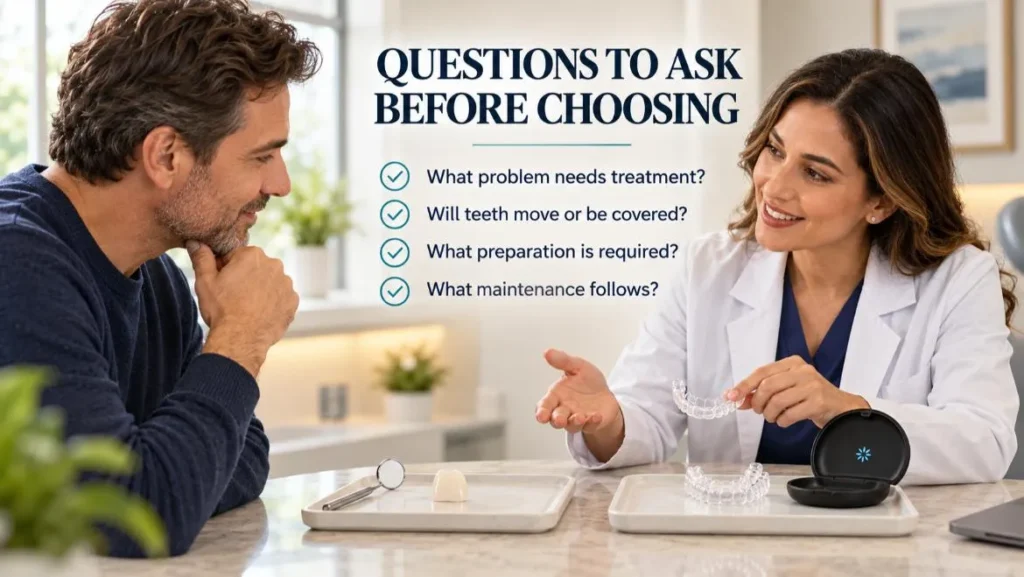
Bring clear goals to your appointment, but stay open to a different diagnosis. Useful questions include:
- Is my concern caused by tooth position, tooth shape, color, damage, or a combination?
- Are my teeth and gums healthy enough to begin treatment now?
- Could whitening, bonding, contouring, or limited orthodontics achieve my goal more conservatively?
- If I choose veneers, exactly how much enamel would be removed from each tooth?
- If I choose Invisalign, will I need attachments, elastics, enamel reshaping, refinements, or long-term retainers?
- If both treatments may help, which should come first and why?
- What complications are realistic in my case, and how would they be managed?
- What is included in the written fee, and what future expenses should I expect?
A good veneers vs Invisalign consultation explains the diagnosis, alternatives, compromises, maintenance, and total commitment—not just a simulated after-photo.
Frequently Asked Questions
Are veneers better than Invisalign for crooked teeth?
In veneers vs Invisalign, neither is automatically better for crooked teeth. Veneers may camouflage mild irregularities but do not move roots or correct a bite. Invisalign moves teeth. The choice depends on crowding, enamel health, bite, color, and shape.
Is Invisalign cheaper than veneers?
The cost of veneers vs Invisalign depends on the case. Invisalign is priced as an orthodontic plan, while veneers are commonly priced per tooth. Compare complete written estimates, not advertised starting prices.
Can Invisalign fix chipped or discolored teeth?
No. Invisalign can move a chipped or discolored tooth, but it does not rebuild the chip or change the tooth’s underlying shade. Bonding, whitening, a veneer, or another restoration may be considered after alignment when appropriate.
Can veneers replace the need for Invisalign?
In veneers vs Invisalign, veneers replace alignment only when the concern is cosmetic and tooth positions and bite are acceptable. Masking substantial crowding may require aggressive preparation and miss functional problems. An orthodontic opinion can clarify the safest path.
Should I whiten before getting veneers?
If whitening is part of the plan, it is often completed before the final veneer shade is selected because porcelain does not whiten later. Timing should be coordinated with the treating dentist so the color stabilizes and surrounding teeth match the planned restorations.
Can I get Invisalign if I already have veneers?
Sometimes. Aligners can move teeth with veneers or other restorations, but attachment bonding, restoration condition, margins, and force planning require extra care. The dentist or orthodontist must evaluate the existing veneers before treatment.
Which option looks more natural?
Either can look natural when appropriately planned. Invisalign retains your natural tooth surfaces and changes alignment. Well-designed veneers can closely imitate enamel, but shade, translucency, contour, preparation, and laboratory quality influence the result. “Natural” should mean harmonious with your face and neighboring teeth, not simply very white.
The Bottom Line
The core veneers vs Invisalign decision is whether you need to change the visible surface of teeth or their position. Veneers can refine color, shape, size, and selected defects, but they involve bonded restorations and may require irreversible enamel preparation. Invisalign can improve alignment and certain bite concerns, but it demands consistent wear and long-term retention.
Sometimes the most conservative plan is Invisalign alone. Sometimes a small amount of bonding or a carefully selected veneer is enough. And sometimes alignment followed by limited cosmetic treatment produces a better result than either option by itself. Start with a complete examination, understand every alternative, and choose the plan that protects oral health while meeting a realistic smile goal.
This article contains affiliate links. If you purchase through our links, we may earn a commission at no extra cost to you. We only recommend products we genuinely believe in. Read our Affiliate Disclaimer for full details.