



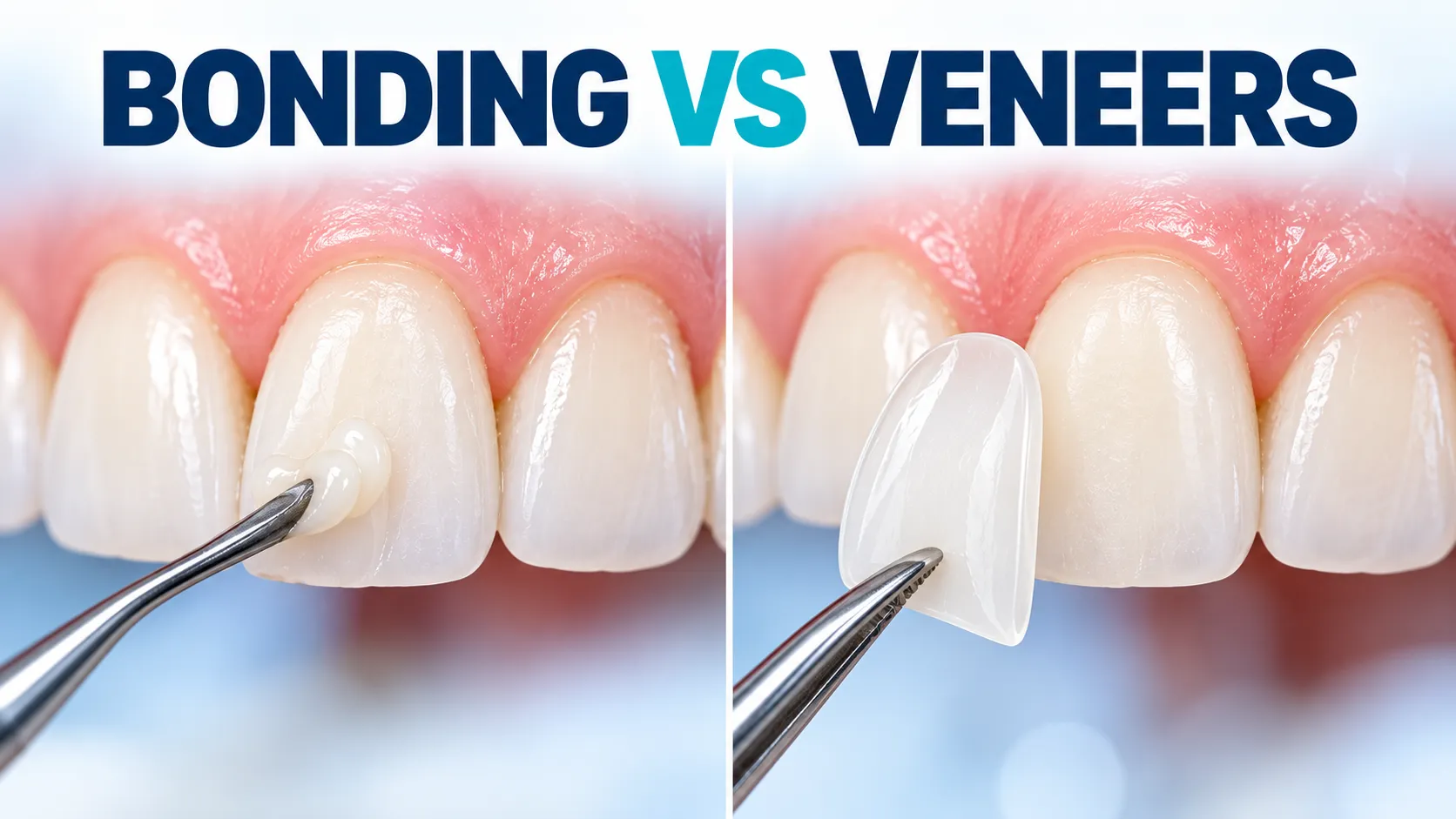
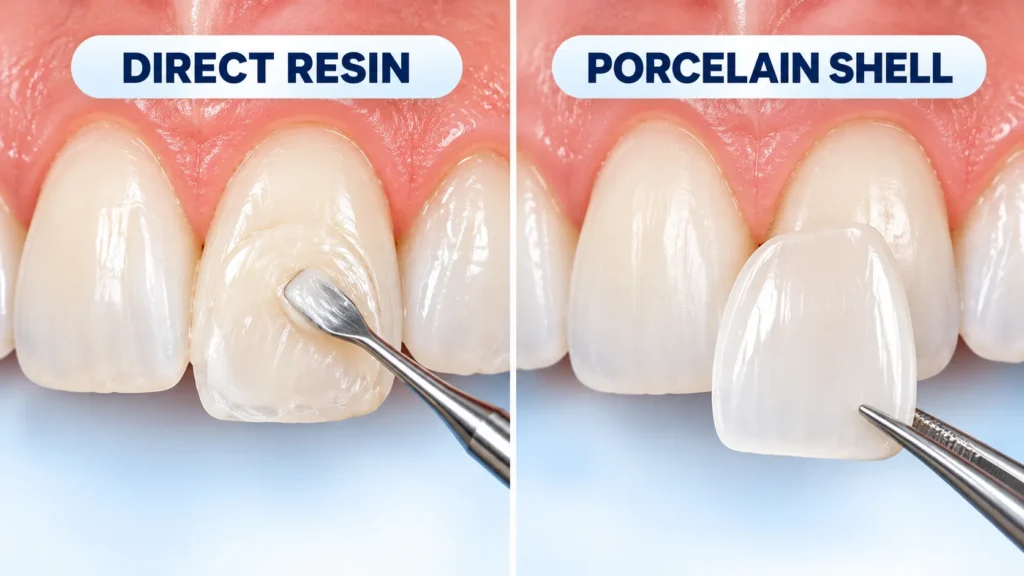
When comparing bonding vs veneers, the simplest difference is this: dental bonding uses tooth-colored composite resin shaped directly on a tooth, while porcelain veneers are custom ceramic shells bonded over the visible front surface. Bonding often suits smaller, localized changes. Veneers may suit broader changes in color, shape, proportion, or symmetry. Neither is automatically better, and both require healthy teeth, stable gums, and a bite that the restoration can tolerate.
Table of Contents
Bonding vs Veneers: The Direct Answer
For a small chip, narrow gap, slightly uneven edge, or one tooth that needs a modest shape adjustment, bonding may be the more conservative starting point. The dentist adds composite resin only where it is needed, hardens it with a curing light, then shapes and polishes it. Treatment is often completed in one visit, although the appointment length depends on the number of teeth and the complexity of the work.
Porcelain veneers cover more of the visible tooth surface. They can coordinate several changes at once, such as persistent discoloration, uneven proportions, worn edges, and a broader smile-design concern. Because veneers are fabricated outside the mouth, they usually involve planning, records, tooth preparation when required, temporary restorations in some cases, and a later bonding appointment.
The bonding vs veneers decision should therefore begin with the size of the problem and the condition of the tooth. A small repair does not always justify covering an entire front surface. A large cosmetic change may be difficult to achieve predictably with small additions of resin alone.
What Is Dental Bonding?
In bonding vs veneers comparisons, dental bonding—also called composite bonding or tooth bonding—uses a tooth-colored resin that a dentist places directly on enamel. The material can be layered, sculpted, light-cured, adjusted, and polished during the appointment. The current Cleveland Clinic guide to dental bonding describes its use for changing tooth shape, closing spaces, concealing chips or minor cracks, and improving color.
The word “bonding” can describe different amounts of work. A dentist may add a small corner to repair one chip, build out the sides of two teeth to reduce a gap, or cover much of a front surface with composite. That last approach overlaps with what some practices call a direct composite veneer. Our composite resin veneers review explains why it is useful to ask exactly how much of each tooth will be covered.
Bonding generally preserves more existing tooth structure because the treatment often relies on adding material rather than removing substantial enamel. That does not mean every case is completely preparation-free. A dentist may smooth a sharp edge, remove unsupported enamel, roughen a small area, or create space so the final contour does not look bulky.
What Are Porcelain Veneers?
For bonding vs veneers, porcelain veneers are thin custom-made ceramic restorations that cover the visible front surface of teeth. They may also wrap slightly around the sides or extend over the biting edge, depending on the design. The American Dental Association’s veneer guidance explains that a dentist commonly removes a small amount of enamel from the front and sides before placing ceramic veneers.
Veneers are not simply pieces of white material glued onto any tooth. The dentist must evaluate enamel, old fillings, cracks, decay, gum position, tooth alignment, and bite forces. The ceramic thickness, opacity, surface texture, edge position, cement shade, and underlying tooth color all influence the result.
In bonding vs veneers planning, porcelain is usually considered when a patient wants a coordinated change across most of the visible surface of one or more teeth. It can be especially useful when color stability, surface texture, and control over several tooth proportions are priorities. It is still a restorative commitment rather than a temporary cosmetic accessory.
Bonding vs Veneers at a Glance
| Decision factor | Dental bonding | Porcelain veneers |
| Material | Direct tooth-colored composite resin | Custom laboratory-made dental ceramic |
| Coverage | Localized addition or broader direct resin coverage | Covers most of the visible front surface |
| Typical timing | Often one visit | Usually multiple stages and visits |
| Tooth preparation | Often minimal, but varies | Commonly includes enamel reduction; varies by design |
| Repairability | Small chips may often be repaired directly | Repairs can be less predictable; replacement may be needed |
| Stain behavior | More likely to discolor or lose polish over time | Ceramic is generally more stain resistant |
| Best suited to | Modest chips, gaps, contour changes, or trial changes | Broader color, shape, proportion, or multi-tooth changes |
| Insurance | Commonly considered cosmetic | Commonly considered cosmetic |
This bonding vs veneers table summarizes typical patterns, not guarantees. A large composite build-up may be more involved than a very conservative veneer, and a veneer on one tooth may be simpler than reshaping several teeth with bonding. Material choice is only one part of the clinical design.
When Bonding May Make More Sense in Bonding vs Veneers
In bonding vs veneers planning, bonding may be appealing when the desired change is limited and the underlying tooth is healthy. Common examples include a small chipped corner, a minor length difference, a narrow space, a slightly pointed tooth, or an isolated area of discoloration. It can also be used as a transitional or trial treatment when a person wants to preview a shape change before considering ceramic.
Another advantage in bonding vs veneers is repairability. If a small piece of resin chips, a dentist may be able to roughen, add, cure, and polish new material without replacing the entire restoration. Whether this is possible depends on the location of the chip, the remaining material, the bite, and the reason the failure occurred.
Bonding can also make financial planning easier because it generally involves less laboratory work. Still, “less expensive” should not be confused with “cheap forever.” Resin may need polishing, touch-ups, repair, or replacement over time. Repeated maintenance can change the long-term cost.
Bonding is not automatically conservative if it creates thick, overcontoured teeth or if it is used to camouflage a bite or alignment problem better handled with orthodontics. The dentist should explain what is being added, where it will sit, and how the new contour will affect cleaning and gum health.
When Veneers May Make More Sense in Bonding vs Veneers
Veneers may be discussed when the desired change affects most of a tooth’s visible surface or several neighboring teeth. Examples include deep color differences that whitening cannot correct, multiple worn edges, irregular proportions, widespread surface defects, or a smile-design plan that requires consistent shape and texture across several teeth.
Porcelain can provide a highly polished surface and stable color when the material, preparation, adhesive technique, and bite are appropriate. A skilled dental laboratory can build subtle variations in translucency, texture, and edge character so the result does not look like a row of identical blocks.
In bonding vs veneers, veneers may also reduce the number of visible material transitions across a tooth because one ceramic shell covers the planned facial surface. Yet broader coverage is not automatically better. If most enamel is healthy and the concern is tiny, covering the full front surface may be more treatment than the tooth needs.
A veneer also needs a dependable foundation. Extensive existing fillings, active decay, an unfavorable crack, very limited enamel, or severe grinding may change the recommendation. Sometimes another restoration, orthodontic movement, whitening, or no treatment is more sensible.
Tooth Preparation and Reversibility in Bonding vs Veneers
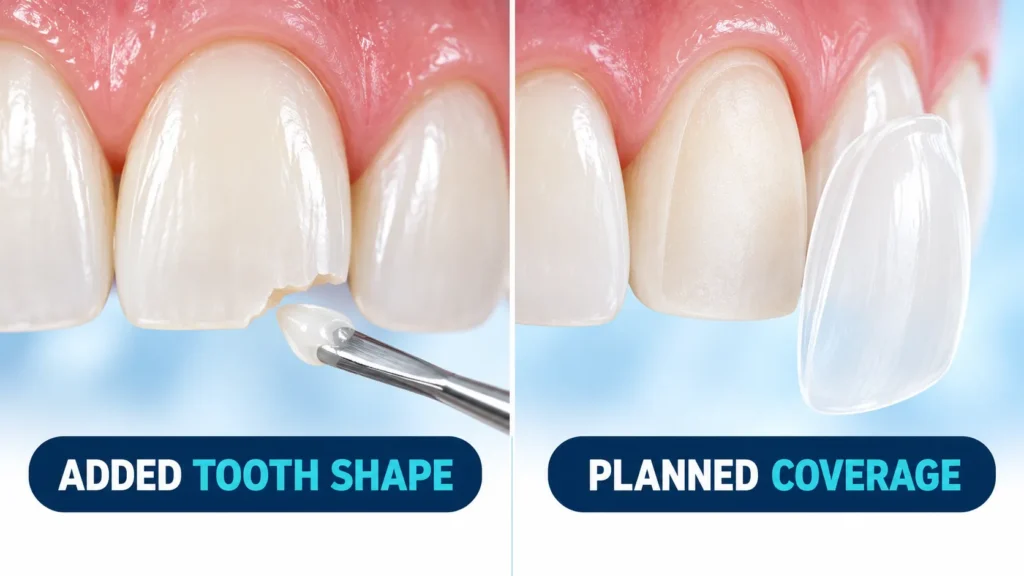
In bonding vs veneers discussions, bonding is often described as reversible because many treatments require little or no enamel removal. That description needs context. Removing composite later may still require careful instrumentation, and it can be difficult to distinguish resin from natural enamel perfectly. A tooth that was reshaped before bonding may not return to its exact starting condition.
Porcelain veneers are usually an irreversible commitment when enamel is removed. Once a tooth has been prepared, it normally needs ongoing coverage with a veneer or another suitable restoration. Designs range from very limited preparation to more substantial reduction, depending on tooth position, color, contour, and the intended result.
The most useful bonding vs veneers question is not “Will my teeth be shaved?” but “Exactly how much tooth structure will be changed on each tooth, and why?” Ask to see the proposed design on a model, scan, photograph, or mock-up. Our guide to tooth shaving and preparation for veneers shows why preparation cannot be described with one universal measurement.
Durability, Staining, and Repairs in Bonding vs Veneers
For bonding vs veneers, there is no single lifespan that applies to every patient or every restoration. Direct composite can provide satisfactory service in anterior teeth, but maintenance and failure patterns vary. A systematic review of anterior composite restorations found that fracture was a common reason for failure, while color, form, and surface staining were more frequent concerns when composite was placed for aesthetic reasons.
Porcelain veneers also chip, fracture, debond, or develop margin problems in some cases. Their performance depends on the ceramic, enamel available for bonding, preparation design, adhesive technique, tooth position, and bite. The ADA’s review of materials for indirect restorations summarizes evidence showing favorable veneer survival while also emphasizing that materials and clinical circumstances differ.
In everyday bonding vs veneers maintenance, composite is more likely to pick up stains, lose surface gloss, or need polishing. Porcelain is generally more color stable, but the natural tooth and cement margin can still change. Neither option prevents cavities or gum disease around the restoration.
Do not choose solely from an advertised lifespan. Ask what counts as “failure,” which problems can be repaired, how often polishing is included, what happens if the bite chips an edge, and what the practice charges for maintenance or replacement.
Cost and Insurance in Bonding vs Veneers
In bonding vs veneers cost comparisons, bonding commonly costs less per tooth because the dentist places it directly without a separate ceramic laboratory restoration. The actual fee depends on the number of teeth, the amount of resin, the complexity of the shape change, local costs, the clinician’s time, and whether old material must be removed.
Porcelain veneers typically cost more because they involve detailed planning, provisional stages in some cases, laboratory fabrication, try-in, and adhesive placement. A written estimate should state whether records, mock-ups, temporary veneers, laboratory fees, follow-up adjustments, a nightguard, and future repairs are included.
Cost comparisons can be misleading when a small bonded repair is compared with a full-surface veneer. For a broader look at common fee variables, see our guide to how much veneers cost.
Most treatment done only to improve appearance is treated as cosmetic, so insurance coverage is often limited or excluded. A restoration performed because of damage may be reviewed differently, but coverage is never automatic. Ask the dental office for the planned procedure codes and request a written pretreatment estimate from the insurer.
For bonding vs veneers, compare the complete maintenance horizon rather than the first invoice alone. A lower initial fee can still involve future polishing, repair, or replacement. A higher initial fee does not guarantee that a veneer will never need attention.
Bonding vs Veneers: What the Procedures Usually Involve
Typical dental bonding process
- The dentist examines the tooth, gums, bite, and cosmetic concern.
- A matching composite shade is selected.
- The tooth is cleaned and prepared as required.
- Adhesive steps are completed, and resin is layered directly on the tooth.
- A curing light hardens each layer.
- The dentist shapes, polishes, and checks the bite.
Typical porcelain veneer process
- The dentist examines oral health, tooth structure, alignment, and bite.
- Photographs, scans, impressions, and a smile-design preview may be created.
- The tooth is prepared when required.
- A laboratory fabricates the ceramic veneer; temporary coverage may be used.
- The veneer is tried in so fit, contacts, color, and shape can be reviewed.
- The tooth and veneer are treated for bonding, then the bite and margins are checked.
The bonding vs veneers timeline varies by practice and case. Same-day technology may shorten some ceramic workflows, while complex bonding across several teeth can take more than one appointment. Speed should not replace diagnosis, isolation, shade planning, or bite evaluation.
Can Bonding and Veneers Be Used Together?
Yes. A treatment plan may use a porcelain veneer on one tooth that needs broader color or shape control and bonding on another tooth that needs only a small addition. The challenge is matching the color, texture, gloss, and aging behavior of two different materials.
Combining treatments should be based on tooth-by-tooth needs, not a package price. The dentist and laboratory should plan the shade and surface character together, especially when bonded resin and ceramic will sit side by side in the center of the smile.
If you are comparing bonding vs veneers across several teeth, ask whether whitening should happen first. Natural enamel may lighten, but existing composite and porcelain do not bleach in the same way. Changing tooth color after restorations are placed can create a mismatch.
How to Decide: Bonding vs Veneers Consultation
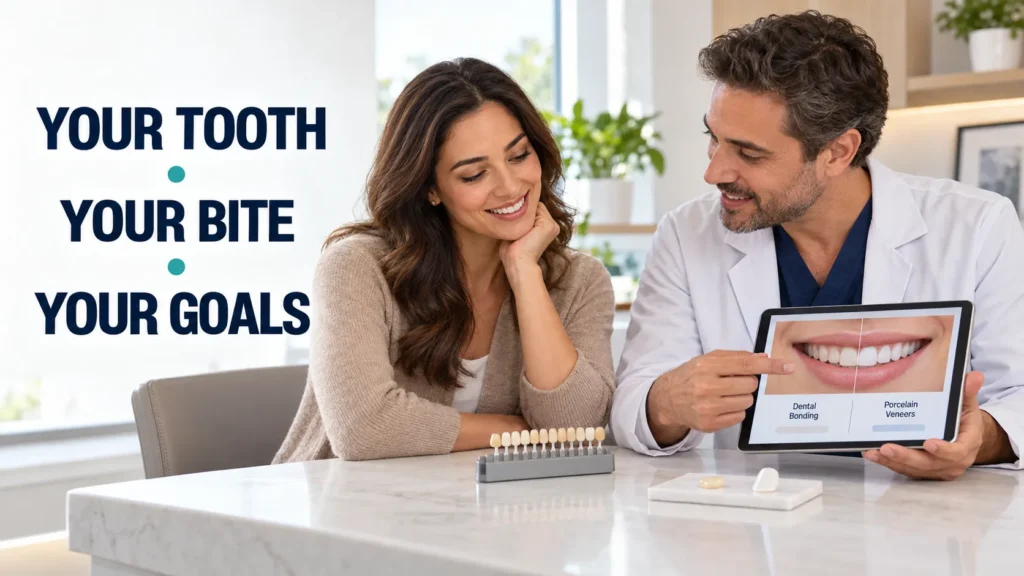
Bring a clear description of what bothers you rather than requesting a material by name. “I want this chipped edge to match the other tooth” gives the dentist a more useful starting point than “I need veneers.” A careful consultation should separate the problem from the proposed restoration.
Ask these questions:
- What diagnosis or cosmetic concern are we addressing on each tooth?
- Is bonding enough to solve it without making the tooth bulky?
- How much enamel would a veneer require removing?
- Can I review a mock-up before making an irreversible change?
- How will my bite and any grinding affect the result?
- Which chips, stains, or margin problems can be repaired?
- What maintenance should I budget for over time?
- Are whitening or orthodontics more conservative alternatives?
The best bonding vs veneers plan may differ from tooth to tooth. A dentist who shows the design, explains alternatives, and discusses future maintenance gives you more useful information than one who promises a universal “perfect” result.
Frequently Asked Questions
Is bonding better than veneers?
Not universally. Bonding may be better for a small repair, a limited shape change, easier repairability, or lower upfront cost. Veneers may be better for a broader change involving most of the visible tooth surface. The correct choice depends on tooth structure, goals, bite, and maintenance expectations.
Does bonding damage your teeth?
Bonding often requires little tooth reduction, but the exact process varies. Some smoothing or preparation may be necessary, and removing old resin later requires care. Ask the dentist to explain what natural tooth structure will be changed before treatment.
Are veneers stronger than bonding?
Porcelain generally resists staining and maintains surface gloss better than composite, but “stronger” is incomplete. Both can chip or debond under unfavorable forces. Design, enamel support, adhesive technique, tooth position, and the bite strongly affect performance.
Which looks more natural in bonding vs veneers?
Either can look natural. Bonding can disappear beautifully in a small repair, while porcelain can offer detailed control of color, translucency, and texture across a larger surface. The result depends more on case selection and execution than the treatment label alone.
Can bonding be replaced with veneers later?
Often, but not automatically. The dentist must remove or manage the old composite, examine the enamel, evaluate the bite, and decide whether a veneer has a reliable foundation. Previous bonding may influence preparation and final color.
Can veneers be replaced with bonding later?
Usually not as a simple reversal. Once enamel has been prepared for a veneer, the tooth commonly needs continued coverage. The replacement design depends on how much tooth remains and why the existing veneer is being removed. Read more in our guide to whether veneers are permanent.
How do I care for bonding and veneers?
Brush twice daily with fluoride toothpaste, clean between teeth every day, and attend dental visits at the interval recommended for your oral health. Avoid using front teeth as tools. Seek care for a rough edge, movement, a changed bite, persistent sensitivity, gum swelling, or darkening near a margin.
Bottom Line
The central bonding vs veneers question is how much change the tooth needs and how much healthy enamel can be preserved. Bonding is often a practical choice for localized additions, small repairs, and changes that benefit from direct repairability. Porcelain veneers can offer broader control of color, surface, and proportion when covering most of the visible tooth is justified.
Choose only after a dentist has examined the teeth, gums, existing restorations, and bite. Ask to see the proposed design, the preparation required on each tooth, realistic maintenance expectations, and reasonable alternatives. A conservative plan solves the actual problem without committing more healthy tooth structure than necessary.
This article contains affiliate links. If you purchase through our links, we may earn a commission at no extra cost to you. We only recommend products we genuinely believe in. Read our Affiliate Disclaimer for full details.