



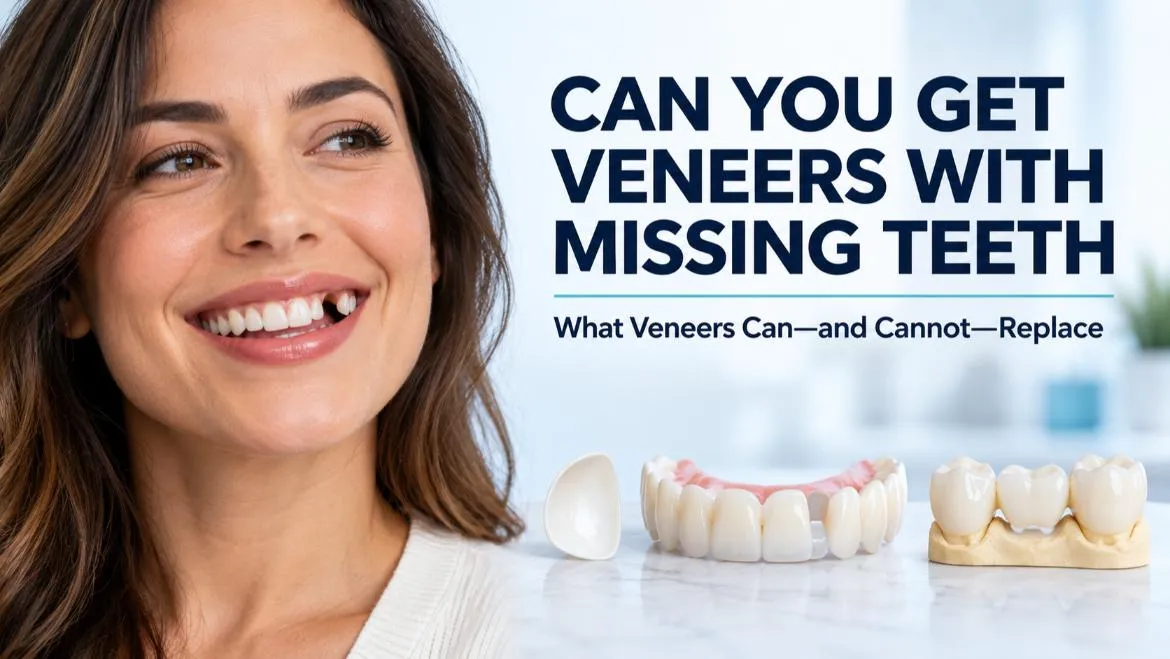
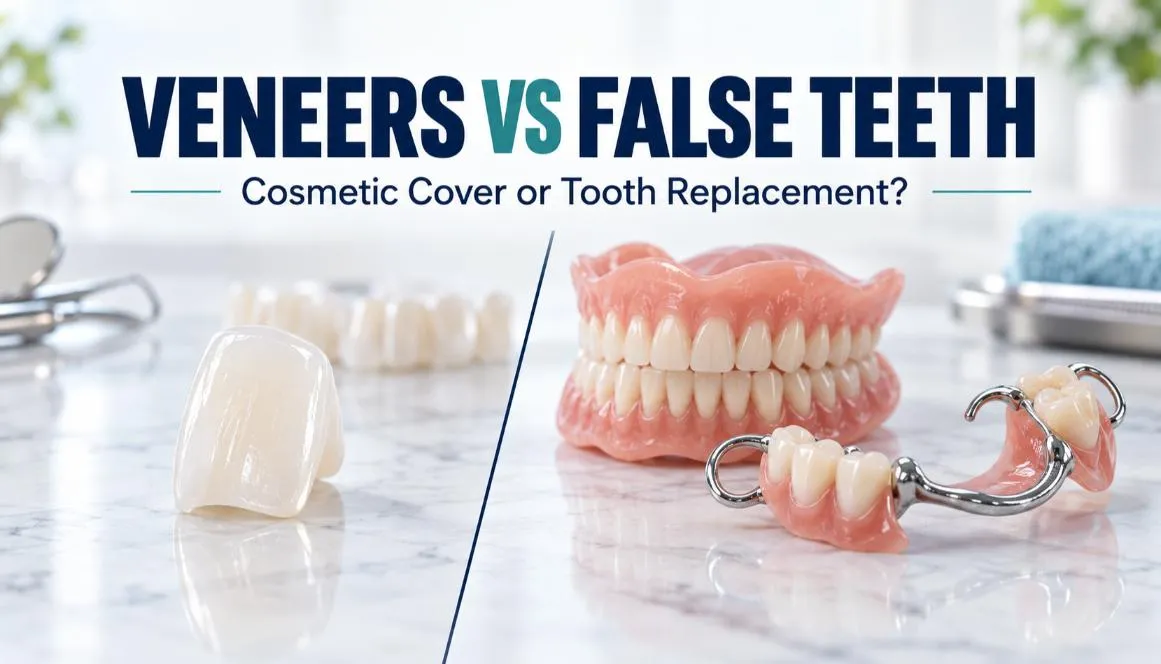
Quick answer: Veneers cover the visible surfaces of teeth that are still present, while false teeth – usually meaning full or partial dentures – replace teeth that are missing. In the veneers vs false teeth decision, the condition and number of remaining teeth matter more than appearance alone. Neither option is automatically better; they solve different problems.
Table of Contents
This distinction sounds simple, but online product language can blur it. Traditional veneers are bonded restorations placed by a dentist. Dentures are custom dental appliances that replace some or all teeth. Removable clip-on veneers sit in a third category: they may cosmetically cover visible gaps while worn, but they do not replace tooth roots or restore the full function of a denture.
This article provides general information, not personal dental advice. Pain, swelling, bleeding, loose teeth, recent tooth loss, broken teeth or suspected infection should be assessed by a licensed dentist before any cosmetic appliance is considered.
Veneers vs False Teeth at a Glance
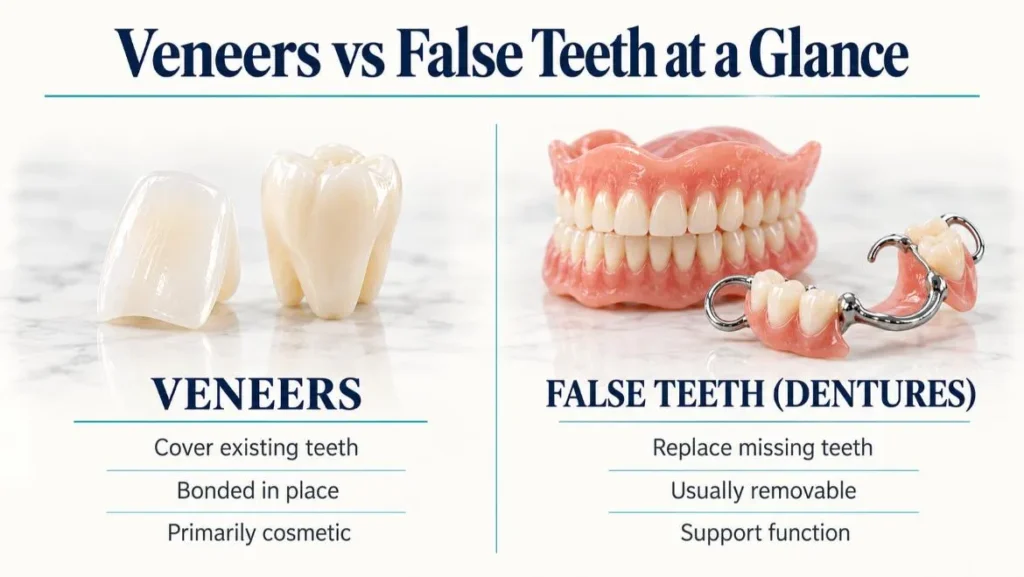
The fastest way to understand veneers vs false teeth is to ask whether the natural tooth is present. A veneer needs a tooth to support it. A denture fills spaces where teeth have been lost. The table below shows why these are not interchangeable purchases.
| Decision factor | Traditional veneers | False teeth (dentures) |
| Main purpose | Improve the visible color, shape or surface of existing teeth | Replace missing teeth and support appearance, speech and chewing |
| Natural teeth required | Yes, each veneer needs a suitable tooth | Full dentures do not; partial dentures use remaining teeth and gums for support |
| Fixed or removable | Usually bonded and not removable at home | Full and partial dentures are generally removable; some implant-supported designs are fixed |
| Treatment setting | Planned and placed by a dentist | Examined, designed, fitted and adjusted through dental care |
| Tooth preparation | Often involves some enamel reduction; the amount varies | May involve extractions or preparation of supporting teeth, depending on the case |
| Function | Primarily cosmetic, although it changes the tooth surface | Designed to replace missing teeth and improve oral function |
| Ongoing care | Natural teeth, margins and gums still need daily care | Appliance and mouth require daily cleaning plus periodic fit checks |
The most important takeaway is that veneers vs false teeth is not simply a contest between two smile styles. It is a choice between covering existing tooth structure and replacing absent teeth.
What Veneers Actually Do
Traditional dental veneers are thin shells made from porcelain or tooth-colored resin. They attach to the front surface of selected teeth to change visible features such as shape, shade, proportion, small chips or certain spaces. The American Dental Association’s overview of veneers explains that a small amount of enamel is typically removed to accommodate the restoration.
Because veneers depend on the tooth beneath them, a dentist must evaluate enamel, decay, cracks, gum health, bite forces and grinding. A severely weakened or absent tooth needs a different plan.
Porcelain and composite veneers
Porcelain veneers are made outside the mouth and bonded during a later visit. Composite veneers are shaped from resin directly on the tooth or fabricated indirectly. Porcelain generally offers strong stain resistance, while composite may be easier to repair.
Neither material grows back if enamel is removed. That makes the decision a long-term commitment rather than a temporary beauty service. Our guide to tooth shaving for veneers explains why preparation varies instead of following one universal amount.
Why veneers cannot replace a missing tooth
A veneer is a facing, not a complete artificial tooth. If there is no natural tooth, there is nothing appropriate for the shell to bond to. A dentist may discuss a bridge, implant or partial denture for a gap, depending on oral health, bone, nearby teeth and budget.
This is one of the most important points in any veneers vs false teeth comparison. Veneers may make remaining teeth coordinate with a replacement, but the veneer itself does not replace the root, crown and chewing support of a lost tooth.
What “False Teeth” Usually Means
“False teeth” is an everyday phrase rather than one exact product name. Most people mean dentures: removable appliances with artificial teeth attached to a gum-colored base. Dentures may replace an entire arch or only several missing teeth.
The Cleveland Clinic’s denture guide describes full, partial, immediate, implant-retained and implant-supported designs. Each has a different support system, treatment process and maintenance routine, so a general veneers vs false teeth search can lead to several possible clinical discussions.
Full dentures
A complete denture replaces all teeth in the upper jaw, lower jaw or both. It rests on the gums and underlying ridge, although some designs use dental implants for greater retention. In veneers vs false teeth, this is the clearest divide: a full denture replaces an arch; veneers require teeth.
Full dentures include an artificial gum base and a complete row of teeth arranged to work together. They require professional fitting and adjustment as the tissues beneath them change.
Partial dentures
A partial denture replaces one or more missing teeth while preserving remaining teeth. It may use acrylic or a metal framework, with clasps or other components for support. Unlike a veneer, the replacement tooth occupies an actual gap. This makes veneers vs false teeth a functional as well as cosmetic comparison.
Partial dentures can improve appearance, speech and chewing. Their design depends on which teeth remain and whether those teeth can support the appliance.
Implant-retained and implant-supported dentures
Some dentures connect to implants placed in the jaw. Implant-retained dentures may be removable by the wearer, while certain implant-supported designs can be removed only by a dental professional. These treatments require clinical planning.
The Biggest Differences in Daily Life
The clinical definition is only part of veneers vs false teeth. Daily wear feels different because one option is attached to natural teeth and the other replaces missing structures.
Chewing and speech
Well-planned veneers should preserve normal tooth function, but they are not intended to turn a weak tooth into a strong one. Biting hard objects, grinding or an unfavorable bite can chip either the veneer or supporting tooth.
Dentures help restore function after tooth loss, although adaptation takes time. New wearers may need to practice speaking and begin with manageable foods. A loose or painful denture needs professional adjustment.
Cleaning and overnight wear
Veneered teeth are brushed and cleaned between like other teeth, with special attention to the gumline and restoration margins. The underlying teeth can still develop decay, and the gums can still become inflamed.
Removable dentures need separate appliance cleaning as well as care of the gums, tongue and any remaining teeth. Many removable dentures are taken out at night so the tissues can rest, but individual instructions depend on the design and dentist’s guidance. Cleaning advice for bonded veneers should never be copied automatically to dentures.
Fit changes over time
Bonded veneers do not become loose because the jaw ridge changes after tooth loss, but their margins, supporting teeth and bite still need monitoring. Dentures interact directly with tissues that can change shape, so relining, rebasing, adjustment or replacement may eventually be needed.
The American College of Prosthodontists’ denture guidance notes that dentures have limited service lives and should be examined when fit, stability, support, condition or comfort changes. In practical terms, veneers vs false teeth also means different kinds of follow-up care.
Where Removable Clip-On Veneers Fit
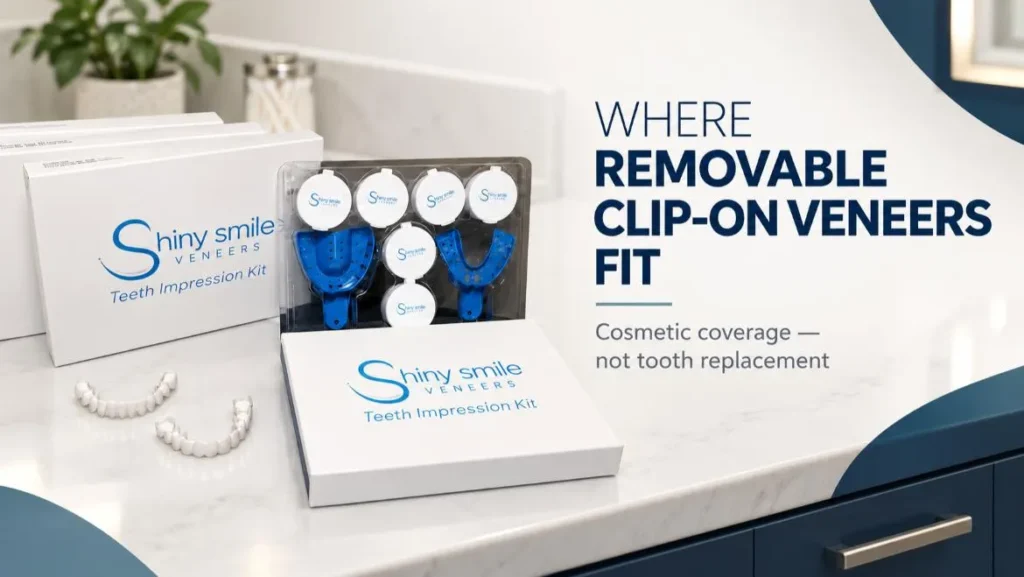
Removable clip-on veneers are cosmetic appliances that sit over visible teeth. Custom products are commonly made from at-home or professionally taken impressions. They may change the appearance of color, shape, spacing or a limited visible gap while worn, but they are neither bonded dental veneers nor dentures.
This third category is why veneers vs false teeth can become confusing. Marketing may use “snap-on teeth,” yet a removable cosmetic cover does not replace roots, preserve bone, treat disease or provide the same chewing function as a denture.
Some manufacturers may accept particular missing-tooth patterns when enough healthy teeth remain to retain the appliance. Eligibility is brand- and case-specific. Our guide to snap-on veneers for missing teeth explains the difference between visually filling a gap and clinically replacing a tooth.
When a removable cosmetic cover may be considered
A person with stable remaining teeth who wants a removable appearance change for social situations may wish to research custom clip-on veneers. The product must fit without cutting the gums, creating persistent pressure or interfering significantly with the bite. Manufacturer approval is not a substitute for an oral examination.
Removable veneers should not be used to hide pain, swelling, decay, infection, loose teeth or recent trauma. If the mouth is changing, an impression-based appliance can quickly become unsuitable.
When dentures address the real need
If several teeth or a full arch are absent and the goal includes eating and speaking – not simply changing a photograph – dentures belong in the conversation. A dentist can assess the gums, remaining teeth, jaw relationship and bone before designing the appliance.
Readers comparing a specific cosmetic brand with a replacement appliance can also see our Pop On Veneers vs dentures comparison. The central distinction remains consistent: one covers an appearance while worn; the other is designed to replace missing teeth.
Procedure, Comfort and Appearance
Traditional veneers begin with an examination and treatment planning. After any required preparation, the dentist bonds the restorations and checks the bite, margins and sensitivity.
Denture treatment includes evaluating the mouth, taking impressions or scans, recording the bite and completing fittings. Follow-up visits are normal because pressure areas and retention may need adjustment.
Appearance depends on more than whiteness. Veneers must harmonize with neighboring teeth and gum contours. Denture teeth and the base must support the lips and work with speech and bite. For veneers vs false teeth, individualized design matters more than choosing the brightest shade.
Comfort also differs in the veneers vs false teeth decision. Veneers become part of the tooth surface, while removable dentures occupy space over the gums and may feel unfamiliar at first. Persistent pain, sores, rocking, clicking or difficulty functioning deserves professional review.
Cost and Insurance Considerations
There is no fair single price for veneers vs false teeth. Veneers are usually quoted per tooth, so the total depends on material, number of teeth, laboratory work and other care. Because treatment is commonly cosmetic, dental benefits may offer limited or no coverage.
Denture costs vary by design, materials, extractions, adjustments, relines and implant involvement. Benefits may contribute when treatment is medically necessary, but plan rules vary. In a veneers vs false teeth cost comparison, an itemized estimate is more useful than two headline prices.
Do not choose dentures only because they appear cheaper or veneers because they seem more permanent. First confirm which category can address the actual condition.
Who May Be a Candidate?
A possible veneer candidate generally has teeth that are present, reasonably healthy and suitable for bonding, with cosmetic concerns that veneers can address. Gum health, enamel, decay, cracks, bite and grinding habits all influence the plan.
A possible denture candidate has one, several or all teeth missing, or teeth that cannot be retained. A dentist must decide whether a full denture, partial denture, bridge, implant option or combination is appropriate. That diagnosis should lead the veneers vs false teeth decision.
Someone interested in removable clip-on veneers should have stable oral health and a tooth pattern accepted by the manufacturer. In veneers vs false teeth, cosmetic coverage should never delay diagnosis or necessary treatment.
Questions to Ask Before Choosing
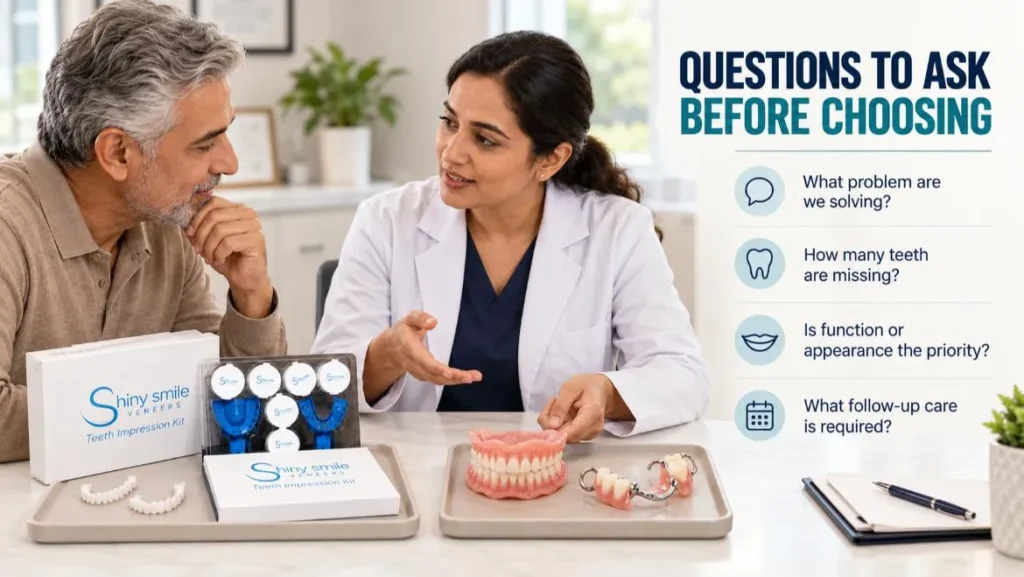
Bring the veneers vs false teeth question back to the problem you need solved. These questions make a dental consultation more productive:
- Are my concerns mainly color and shape, or are teeth actually missing?
- Are the remaining teeth and gums healthy enough to support the proposed option?
- Will any enamel be removed, and is the plan reversible?
- Is the appliance fixed, removable by me or removable only by a dentist?
- What can I realistically eat while using it?
- What cleaning, adjustment and replacement costs should I expect?
- How will grinding, dry mouth, medications or my bite affect the result?
- What happens if the restoration chips, the denture becomes loose or the appliance hurts?
Ask for a written treatment plan and itemized estimate. If veneers vs false teeth would involve removing teeth that might be saved or irreversible preparation, a second clinical opinion can be reasonable.
Frequently Asked Questions
Are veneers considered false teeth?
Traditional veneers are artificial shells, but they are not usually what people mean by false teeth. They cover existing teeth instead of replacing missing ones. Dentures are the more common meaning of false teeth.
Which looks more natural: veneers or dentures?
Either can look natural when well designed. The result depends on materials, tooth proportions, shade, gum contours, facial features and clinical execution. A product category alone does not guarantee realism.
Can I get veneers if I am missing teeth?
Veneers may be placed on suitable remaining teeth, but they cannot replace an absent tooth. A dentist may coordinate veneers with a bridge, implant or partial denture. Removable veneers may cosmetically cover certain gaps while worn, depending on eligibility.
Can false teeth be permanent?
Most conventional full and partial dentures are removable. Some implant-supported full-arch restorations are fixed and can be removed only by a dental professional. “Permanent dentures” is therefore a broad marketing phrase that should be clarified.
Are removable veneers the same as partial dentures?
No. Removable veneers are cosmetic covers, while partial dentures replace missing teeth and are designed with functional support in mind. Their eligibility, care and clinical purpose differ.
Do veneers or dentures last longer?
Both have limited service lives. Material, fit, oral health, bite, care and tissue changes affect longevity. Dentures may need relining as the mouth changes; veneers may need repair or replacement if they chip, debond or develop margin problems.
Is veneers vs false teeth a decision I can make online?
Online research can clarify terminology and prepare questions, but it cannot determine tooth prognosis, gum health, bite or denture support. A dentist must examine the mouth before recommending irreversible veneers or a tooth-replacement plan.
Bottom Line
The veneers vs false teeth comparison becomes much easier once the goal is clear. Veneers change the visible surfaces of existing teeth. False teeth – usually full or partial dentures – replace teeth that are missing and may restore aspects of chewing and speech.
Removable clip-on veneers sit between those categories only in appearance: they can provide temporary cosmetic coverage while worn, but they do not replace teeth or dental treatment. Start with oral health and function, then consider appearance, cost and convenience. The best option is the one designed for the condition that actually exists – not the label that sounds most attractive online.
This article contains affiliate links. If you purchase through our links, we may earn a commission at no extra cost to you. We only recommend products we genuinely believe in. Read our Affiliate Disclaimer for full details.