



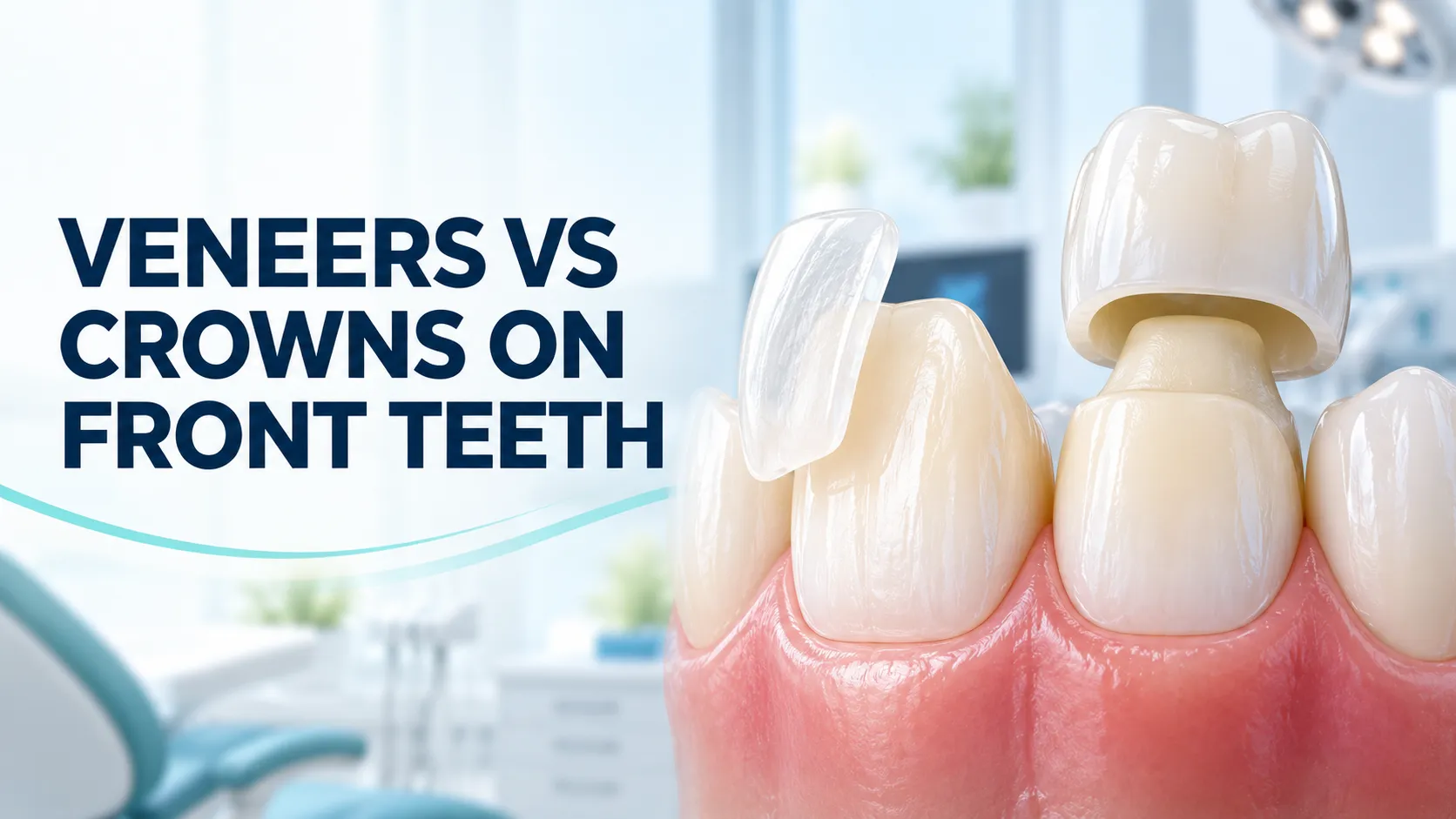
Difference between veneers and crowns, the practical difference is coverage and purpose. A veneer covers mainly the visible front of a tooth and is usually considered when a reasonably healthy tooth needs a cosmetic change. A crown covers the visible tooth much more completely and can restore a tooth that has lost substantial structure. The right choice depends on an examination, not appearance alone.
Table of Contents
Difference between veneers and crowns: The Direct Answer
When comparing difference between veneers and crowns, start with the condition of the tooth. A veneer may suit a tooth that is largely intact but has a visible concern such as persistent discoloration, an uneven shape, a small chip, or a gap. A crown may be considered when the tooth needs broader structural coverage because it is extensively broken down, worn, cracked, or occupied by a large restoration.
The American Dental Association describes a veneer as a custom covering for the front surface of a tooth. Its consumer guidance also says veneer treatment is generally irreversible because enamel may be removed. A crown, by comparison, covers a tooth to restore shape, size, strength, and appearance. The ADA notes that crowns can strengthen teeth with large fillings and protect weak or broken teeth.
That does not make a crown a stronger version of a veneer for every situation. Removing sound tooth structure simply to obtain full coverage can be unnecessarily aggressive. It also does not make a veneer the conservative answer in every case: a veneer needs a suitable foundation and a manageable bite. The goal is to use the least extensive restoration that can predictably solve the actual problem.
What difference between veneers and crowns Actually Cover
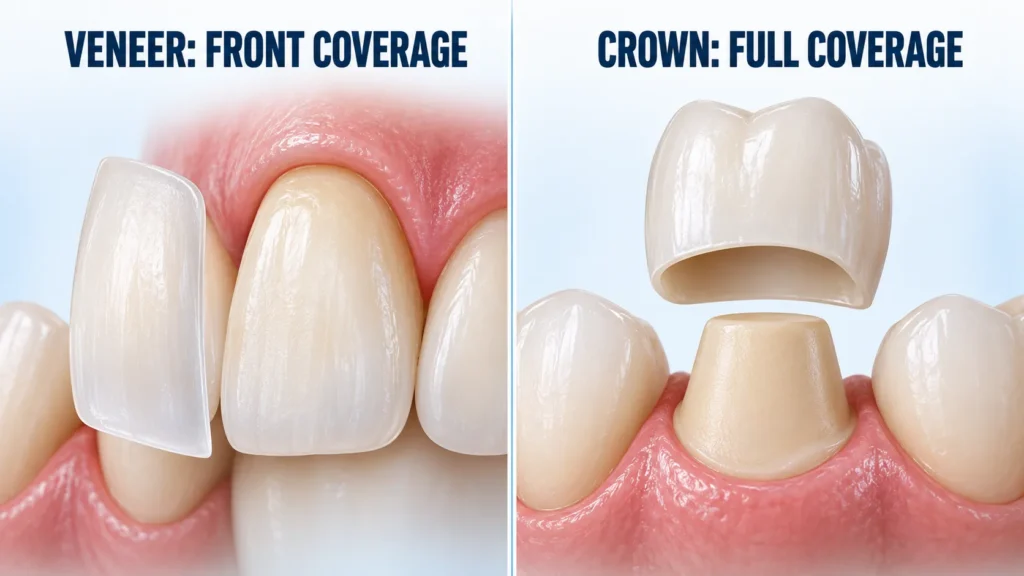
A dental veneer is a thin shell, commonly made from porcelain or another ceramic, that is bonded to the facial surface of a tooth. Depending on the design, it may also wrap slightly around the sides or cover the biting edge. Composite resin can also be shaped directly on a front tooth, although its stain resistance, repair process, and expected maintenance differ from ceramic.
A dental crown is a cap that fits over the prepared visible portion of a tooth above the gumline. Front tooth crowns are commonly made from tooth-colored ceramic systems, but the exact material depends on strength, space, shade, the underlying tooth color, the bite, and the clinician’s laboratory plan.
Preparation is not identical in every case. Some veneer designs remove very little enamel, while others need more reduction to correct position, color, or contour. Crown preparation is usually more extensive because space is required around the tooth. For a closer look at how preparation can vary, read our guide to tooth shaving and preparation for veneers.
A Quick Comparison
| Decision factor | Veneer | Crown |
| Coverage | Mainly the visible front surface; design may include the biting edge | Surrounds most or all of the prepared visible tooth |
| Usual purpose | Primarily cosmetic change on a suitable tooth | Restoration of form, function, and appearance when broader coverage is justified |
| Tooth reduction | Often less extensive, but varies by design and starting position | Usually more extensive to create room around the tooth |
| Foundation | Benefits from sufficient healthy enamel and controlled bite forces | Depends on adequate remaining tooth structure, retention, and a sound treatment plan |
| Common concerns | Chipping, debonding, edge staining, color mismatch, decay at exposed margins | Chipping or fracture, loss of cement, margin problems, decay underneath or around the edge |
| Insurance | Often treated as cosmetic; coverage varies | May receive coverage when medically necessary; plan rules and exclusions vary |
The Main Question: How Much Healthy Tooth Remains?
The front tooth veneer vs crown decision often turns on the amount and location of sound enamel and dentin, not the label on the restoration. Bonded porcelain veneers perform best when a dentist can create a design with a dependable adhesive foundation. A literature review indexed by PubMed reported that bonding to enamel, correct adhesive procedures, and appropriate luting materials support a strong veneer complex. When much of the visible surface is already filling material or the tooth has lost substantial structure, the plan becomes less straightforward.
A crown may be reasonable when a front tooth needs circumferential coverage, but it still needs a restorable foundation. A crown cannot rescue every deeply cracked or severely decayed tooth. Decay must be removed, gum and bone support assessed, and any crack evaluated before the dentist decides whether the tooth can be predictably restored.
Existing dental work changes the calculation. A small filling does not automatically rule out a veneer, and a root canal does not automatically mean every front tooth needs a crown. The location and amount of missing structure, discoloration, access opening, cracks, bite, and ability to bond all influence the restoration. This is why an online photo cannot settle difference between veneers and crowns.
Which Problems Can a Veneer Address?
In the difference between veneers and crowns decision, porcelain veneers for front teeth may be discussed when the tooth is healthy enough for adhesive treatment and the main goal is to change what shows in the smile. Examples include a shape discrepancy, a small chip, a narrow gap, uneven length, or color that has not responded acceptably to whitening. The ADA lists chipped, broken, stained, crooked, and misshapen teeth among concerns veneers may improve, while also warning that decay or gum disease should be treated first.
Composite resin is another route for selected cosmetic problems. It may be applied directly and can be easier to repair, while porcelain generally offers different optical properties and stain behavior. If your decision includes resin, our composite resin veneers review explains the material, maintenance needs, and limits in more detail.
A veneer does not treat an infection, stabilize an unrestorable crack, or replace missing structural support. It also does not move teeth or correct the underlying jaw relationship. Orthodontics, bonding, whitening, or no treatment may sometimes preserve more tooth structure while meeting the same cosmetic goal.
When Might a Crown Be Considered for a Front Tooth?
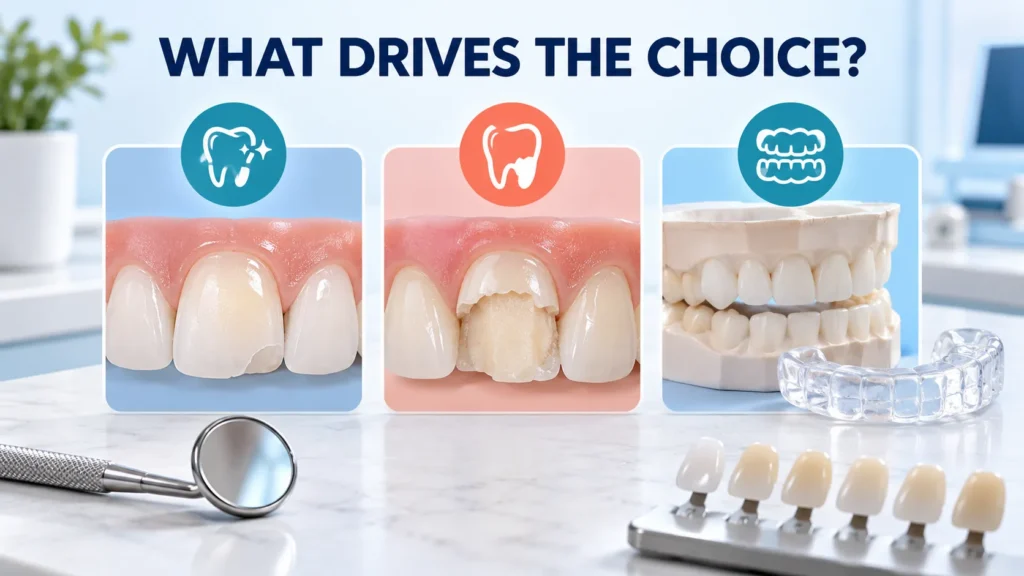
For veneers vs crowns on front teeth, a crown on a front tooth may be discussed when broader coverage is needed to restore a weakened or substantially repaired tooth. The ADA notes that crowns can strengthen a tooth with a large filling, protect a weak tooth, and restore one that is already broken. Cleveland Clinic similarly describes crowns as caps used for decayed, broken, weak, or worn teeth.
Clinical judgment still matters. A large filling, previous trauma, or root-canal treatment is a reason to assess the tooth carefully, not an automatic instruction to place a crown. Dentists consider the remaining walls, crack pattern, ferrule or encircling sound tooth structure, periodontal support, esthetic demands, and bite. In some cases, another bonded restoration may be possible; in others, full coverage may offer a more predictable way to rebuild the tooth.
A crown also cannot solve untreated gum disease or an unfavorable fracture extending too far below the gum. If pain, swelling, a loose tooth, a darkening tooth after trauma, or a draining bump is present, diagnosis comes before cosmetic planning.
Appearance on Front Teeth: Material Is Only Part of the Result
When comparing difference between veneers and crowns, both a veneer and a front tooth crown can look natural when the case is planned and executed well. Neither automatically wins on appearance. Ceramic type, thickness, surface texture, translucency, underlying tooth color, cement shade, neighboring teeth, and laboratory communication all affect the result.
Veneers can preserve more of the natural tooth behind a thin ceramic layer, which may help create lifelike light behavior in a suitable case. A ceramic crown can also reproduce translucency and texture, but masking a very dark underlying tooth or metal post may require a more opaque core or different material strategy. More opacity can control color while making the shade-matching task more demanding.
A single front tooth is often harder to match than a symmetrical group because it must blend with a natural neighbor under daylight, indoor light, flash photography, and different viewing angles. A useful consultation may include photographs, shade mapping, scans or impressions, mock-ups, and discussion of surface texture and edge translucency. Ask whether the proposed material is being chosen for your specific color and bite rather than from a generic claim that one ceramic is always best.
Tooth Preparation and Reversibility
Tooth preparation is a central issue in veneers vs crowns on front teeth. The words “minimal prep” and “no prep” can be misleading without a case-specific design. The ADA states that porcelain veneer placement commonly includes removing a small amount of enamel from the front and sides. Some teeth need limited preparation; teeth that protrude, are rotated, are very dark, or require a major contour change may need more. Adding thickness without creating space can make the result look bulky or affect the gums.
Crowns generally require reduction around the tooth so the restoration can seat, resist forces, and reproduce a natural contour. Once a tooth has been prepared for a crown, returning it to an untreated state is not realistic. Future maintenance usually involves repairing or replacing the restoration rather than simply going without it.
Veneer treatment should also be treated as an irreversible commitment whenever enamel is removed. Even a very conservative veneer may need future rebonding, repair, or replacement. Ask the dentist to show the planned reduction on a model or digital simulation and to explain what alternatives would preserve more tissue.
Bite, Grinding, and Front-Tooth Forces
Bite analysis can change the answer for difference between veneers and crowns. Front teeth guide the jaw during certain movements and bite through food. Deep overbite, edge-to-edge contact, tooth grinding, nail biting, sports trauma, and using teeth to open packages can increase stress on veneers and crowns.
The ADA cautions that clenching, grinding, or a deep overbite may make veneers a poor choice. That does not mean every person who grinds is excluded. It means the bite must be evaluated, risk discussed, and protective strategies considered. A nightguard may be recommended after treatment, while a sports mouthguard can help reduce injury risk during athletic activity.
If the bite is driving wear or fractures, changing the visible surface alone may not address the cause. Orthodontic treatment, bite adjustment within safe limits, replacement of missing posterior support, or management of grinding may need to be part of a broader plan.
What the Procedures Usually Involve
Porcelain veneer process
- Examination, photographs, bite assessment, and any necessary imaging.
- Discussion of goals, alternatives, risks, shade, and the planned number of teeth.
- Tooth preparation when required, followed by a scan or impression.
- A temporary restoration when the preparation and laboratory schedule require one.
- Try-in to review fit, shape, shade, and bite before bonding.
- Adhesive placement, finishing, and follow-up.
Front tooth crown process
- Assessment of decay, cracks, prior restorations, pulp or root-canal status, gums, bone support, and bite.
- Removal of decay or failing material and rebuilding the foundation when necessary.
- Preparation around the tooth, followed by a scan or impression.
- A temporary crown in many conventional laboratory workflows.
- Try-in and checks for margins, contacts, shade, contour, and bite.
- Cementation or bonding according to the restoration and clinical plan.
Same-day digital workflows are available in some practices, but speed should not replace adequate diagnosis, shade communication, isolation, or bite checks. Appointment count also varies with gum treatment, whitening, orthodontics, root-canal care, laboratory work, and whether a provisional stage is needed.
Longevity, Repairs, and Failure Risks
There is no single guaranteed lifespan in veneers vs crowns on front teeth. Cleveland Clinic gives a broad estimate of five to 15 years for dental crowns with proper care, while individual outcomes vary. Systematic reviews of porcelain laminate veneers report generally favorable survival, but the included studies use different materials, preparation designs, clinicians, follow-up periods, and definitions of success. A restoration can remain in place yet still need polishing, repair, rebonding, or treatment for a margin problem.
Veneer complications may include fracture, chipping, debonding, margin discoloration, sensitivity, or decay on uncovered tooth surfaces. Crown complications may include ceramic chipping, fracture, cement loss, decay at a margin, sensitivity, gum irritation, or a need for root-canal treatment. Both depend on the quality of the remaining tooth, design, material, fit, bonding or cementation, hygiene, and bite.
Replacement can require additional treatment because old material must be removed and the tooth reassessed. A chipped composite restoration may sometimes be repaired directly, while a fractured ceramic veneer or crown may need complete replacement. Ask what is repairable, what the practice warranty covers, and what fees apply if the restoration fails after the warranty period.
Cost and Insurance: Compare the Whole Treatment Plan
The cost of veneers vs crowns on front teeth varies by city, dentist, material, laboratory, and case complexity. A useful written estimate should separate the restoration from related services such as examination, imaging, diagnostic wax-up, temporary restorations, foundation buildup, gum treatment, root-canal care, nightguard, and follow-up. Comparing only the advertised per-tooth fee can hide meaningful differences.
Veneers are commonly considered cosmetic. The ADA notes that insurance may not cover a veneer unless it is deemed medically necessary. A crown is more likely to be reviewed as restorative when it is needed to treat a damaged tooth, but coverage is never automatic. Deductibles, waiting periods, annual maximums, replacement-frequency limits, missing-tooth clauses, material downgrades, and preauthorization rules can all affect the amount paid.
Ask the office for the procedure codes it expects to submit and a pretreatment estimate from the insurer. That estimate is useful but is not always a guarantee of payment. Also compare expected maintenance and replacement exposure, not only the first invoice.
Can Veneers and Crowns Be Combined Across the Front Teeth?
Yes. Planning veneers vs crowns on front teeth may result in a crown on a structurally compromised tooth and veneers on neighboring teeth that are suitable for more conservative coverage. The challenge is making different restoration thicknesses and underlying tooth colors appear consistent.
Material selection, laboratory communication, tooth preparation, and cement shade become especially important when a crown and veneer sit side by side. Sometimes treating fewer teeth is possible; sometimes symmetry or severe color differences make a broader plan easier to match. The dentist should explain why every included tooth needs treatment and whether whitening or orthodontics could reduce the number of restorations.
For a broader material-focused comparison beyond the front-tooth decision, see composite veneers vs porcelain crowns.
What About Removable Snap-On Veneers?
A removable cosmetic cover is outside the clinical choice of difference between veneers and crowns. It fits over teeth temporarily and does not become a bonded veneer or a crown. It may alter the appearance of a smile while worn, but it does not treat decay, cracks, infection, gum disease, or structural weakness. It also cannot provide the same individualized emergence profile, margin, bite design, or long-term function as a dentist-planned restoration.
Do not use a removable product to delay care for pain, swelling, trauma, a loose tooth, or suspected decay. A cover can make a problem less visible without making it safer. When the goal is reversible appearance only, ask a dentist whether wearing a removable appliance is appropriate for your teeth and bite.
How to Care for a Veneer or Crown on a Front Tooth

Brush twice daily with fluoride toothpaste and clean between the teeth every day. The restoration itself cannot develop a cavity, but exposed natural tooth and the margin can. The National Institute of Dental and Craniofacial Research explains that tooth decay develops when plaque bacteria and dietary sugars contribute to acid attacks on tooth structure; restorations do not remove that risk from the remaining tooth.
Avoid using front teeth to bite fingernails, pens, ice, hard candy, packaging, or nonfood objects. Seek care if the bite suddenly feels different or if you notice movement, a sharp edge, persistent sensitivity, gum swelling, bad taste, or darkening near a margin. Continue routine dental visits on the interval recommended for your oral health.
Whitening products do not bleach the manufactured shade of porcelain or composite in the same way they can lighten natural teeth. If whitening is planned, discuss timing before the final shade is selected. Our guide to choosing toothpaste for veneers and crowns explains why fluoride, cleaning technique, and the exact material matter more than a dramatic whitening label.
Questions to Ask About Veneers vs Crowns on Front Teeth
During a cosmetic dentistry consultation, ask for a tooth-by-tooth explanation rather than a package recommendation based only on smile photographs.
- What diagnosis or cosmetic concern is each restoration addressing?
- How much healthy enamel and dentin remain on this tooth?
- Why is a veneer or crown more appropriate than bonding, whitening, orthodontics, or no treatment?
- How much tooth structure do you expect to remove, and can you show the design?
- Which material and opacity will be used, and how will a single front tooth be shade-matched?
- Does my bite or grinding pattern raise the chance of chipping or debonding?
- Will I need a temporary restoration, nightguard, gum treatment, or root-canal care?
- What complications are most relevant in my case, and which can be repaired?
- What is included in the written fee, warranty, and follow-up plan?
- Can I review a mock-up or provisional shape before the final restoration is made?
Frequently Asked Questions
Which is better for front teeth, veneers or crowns?
Neither is universally better. The question of veneers or crowns for front teeth depends on the tooth. A veneer may be appropriate for a mainly cosmetic concern on a suitable, largely intact tooth. A crown may be appropriate when a tooth needs broader structural restoration. An examination and bite assessment determine which options are reasonable.
Do crowns always require more tooth removal than veneers?
Crown preparation is usually more extensive because the restoration surrounds the tooth. Veneer preparation varies from very limited to more substantial depending on tooth position, color, and the planned shape. Ask to see the proposed design for your tooth.
Can a veneer go over a front tooth with a large filling?
Sometimes, but a large filling can reduce the amount of enamel available for predictable bonding. The dentist must assess the location of the filling, remaining tooth structure, bite, and whether another restoration would provide a better foundation.
Does a root-canal-treated front tooth always need a crown?
No single rule covers every anterior tooth. The restoration depends on how much structure remains, the size of the access and other restorations, cracks, discoloration, bite forces, and the ability to create a durable bonded or full-coverage design.
Can a crown on a front tooth look natural?
Yes. Modern ceramic crowns can closely reproduce color, texture, and translucency. Matching one central incisor can still be demanding, especially when the underlying tooth is dark. Shade mapping, photographs, material selection, and laboratory communication help.
Can you replace a crown with a veneer later?
Usually not. A tooth prepared for a crown has already been reduced around its circumference and generally needs continued full coverage. The replacement plan depends on the remaining tooth and why the old crown is being removed.
Can veneers and crowns get cavities underneath them?
The porcelain or ceramic cannot decay, but the natural tooth can develop decay at an exposed surface or restoration margin. Daily plaque control, fluoride toothpaste, and regular examinations remain necessary.
Bottom Line
The central issue in dental veneers vs crowns, especially veneers vs crowns on front teeth, is how much healthy tooth remains and what the restoration must accomplish. Veneers primarily change the visible surface of a suitable tooth. Crowns provide broader coverage when rebuilding the tooth requires it. Appearance, preparation, bite, repairability, cost, and future replacement all belong in the same discussion.
Choose after a licensed dentist has examined the tooth, reviewed any necessary imaging, assessed the bite and gums, and explained reasonable alternatives. A conservative plan preserves healthy structure where possible while giving a damaged tooth enough support for predictable function.
This article contains affiliate links. If you purchase through our links, we may earn a commission at no extra cost to you. We only recommend products we genuinely believe in. Read our Affiliate Disclaimer for full details.