



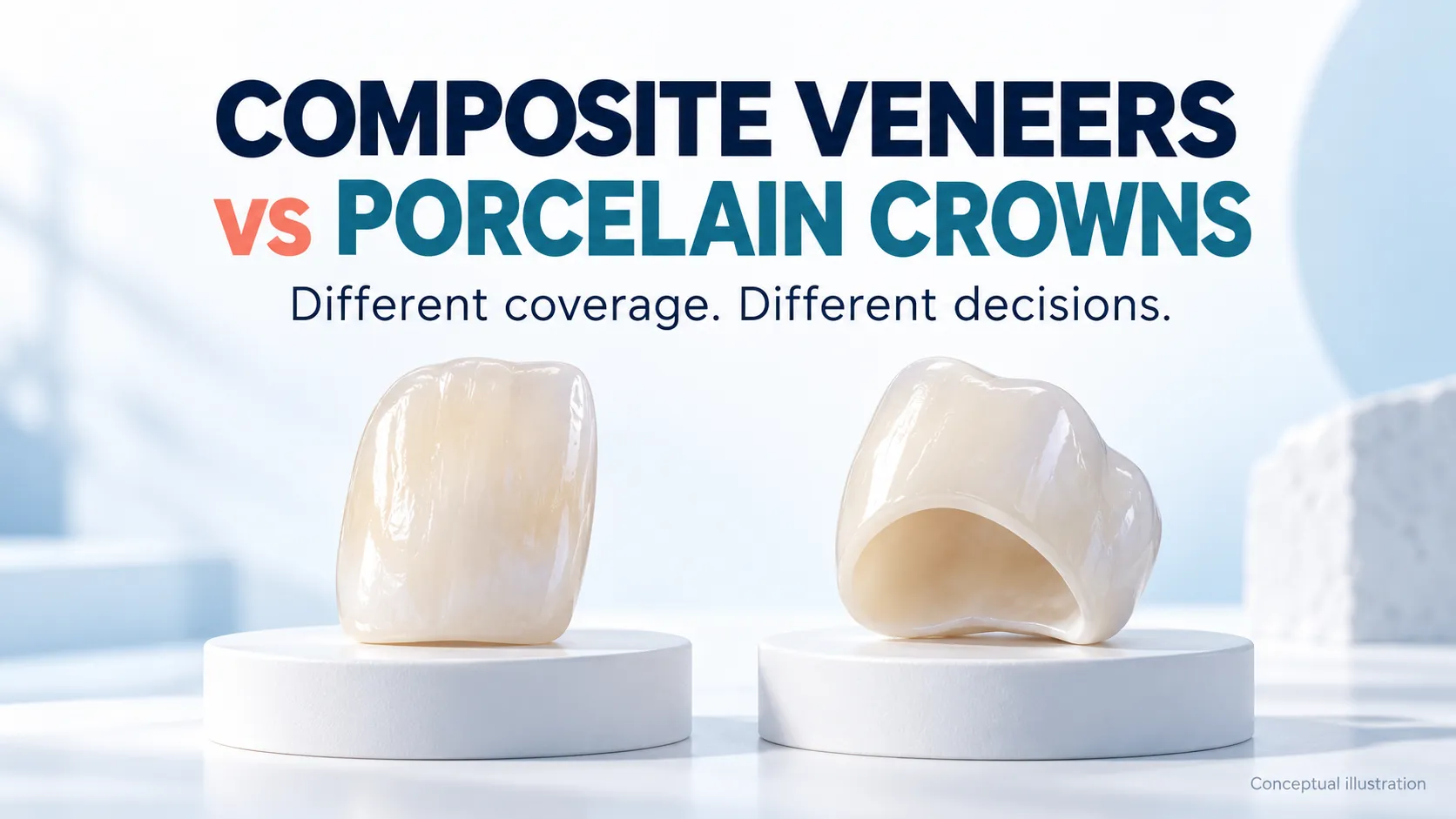
Composite veneers vs porcelain crowns comes down to what the tooth needs: a change to its front surface or more extensive coverage. Composite veneers use bonded tooth-colored resin to change appearance. Porcelain crowns cover the visible tooth and may support damaged structure. A dentist must assess whether either option is appropriate.
Table of Contents
The useful first question is not “Which material is better?” It is “What problem are we treating, and how much healthy tooth can we preserve?” Starting there makes the discussion about price, appearance, and maintenance much more meaningful.
Composite Veneers vs Porcelain Crowns at a Glance
| Decision factor | Direct composite veneer | Porcelain/ceramic crown |
| Coverage | Mainly the tooth’s front surface; may include an edge | Surrounds the visible tooth above the gumline |
| Material | Tooth-colored composite resin | A specified dental ceramic; some crowns use porcelain over another material |
| Common purpose | Selected cosmetic changes to color, shape, chips, or gaps | Restoring and covering a tooth when broader protection is indicated |
| Preparation | May be limited; the actual plan matters | Usually involves reshaping around the tooth and reducing its biting surface |
| Fabrication | Resin is usually sculpted directly in the mouth | Usually laboratory-made; selected ceramic crowns can be made in-office |
| Maintenance | May need polishing, additions, repairs, or replacement | May need adjustment, repair, recementation, or replacement |
| Reversibility | Do not assume it; ask what tooth structure will change | Prepared tooth structure cannot simply be restored by removing the crown |
| Appropriate comparison | A complete veneer quote, not a tiny chip-repair price | A quote identifying the crown material and related treatment |
This table is a conversation starter, not a way to diagnose your own tooth. Similar-looking teeth can have very different histories underneath their visible surfaces.
What Each Treatment Actually Does
Composite veneers change the visible surface
A direct composite veneer is built from tooth-colored resin that a dentist bonds and shapes on a tooth. Unlike a removable clip-on cover, it stays attached during everyday use and requires professional maintenance.
The ADA’s veneer guide describes composite veneers as bonded filling material and notes that they can be easier to fix than porcelain veneers. The extent of the work matters: changing a full front surface is different from adding a little resin to one chipped corner.
When requesting an estimate, ask the office to describe the proposed coverage. “Bonding” may refer to a small repair, a larger reshaping procedure, or a full composite veneer. Comparing those prices without clarifying the work can lead to a misleading conclusion.
For more detail on this treatment category, our composite resin veneers review explains the terminology and maintenance questions to raise at a consultation.
Porcelain crowns provide fuller coverage
A crown is a cap fitted over the remaining visible tooth. According to the ADA’s crown guidance, it can help protect a weakened tooth, support a tooth with a large filling, or restore a broken tooth. It can also change appearance.
“Porcelain crown” needs clarification, too. Ask whether the plan involves an all-ceramic restoration or porcelain fused to metal. The Oral Health Foundation’s crown overview explains these material categories. They should not be treated as one identical product.
This article focuses on crowns supported by natural teeth. An implant crown is a different situation because it attaches to an implant rather than covering a prepared natural tooth.
Which Problems Might Each Option Address
For a cosmetic concern, ask the dentist to separate what you dislike about the appearance from any disease or structural damage they find. A small gap and a heavily restored tooth may appear in the same smile, but they do not automatically need the same treatment.
Composite may be discussed for selected shape changes or limited visible defects. Crown discussions often arise when a tooth needs more extensive restoration. Neither description tells you what your own tooth needs without an examination.
A practical way to approach the consultation is to ask for a tooth-by-tooth explanation:
- What is healthy and worth preserving?
- What is damaged, and how was that established?
- Is the proposed treatment mainly cosmetic, restorative, or both?
- What would a smaller treatment accomplish, and what would it leave unresolved?
There may also be options outside this comparison. Depending on the findings, ask about a localized repair, whitening, orthodontics, a partial-coverage restoration, or leaving a healthy tooth alone. Cleveland Clinic notes that inlays and onlays can be alternatives to full crowns in selected cases.
The point is to understand why the proposed coverage matches the problem. A higher-priced material does not, by itself, justify a more extensive procedure.
Tooth Preparation What Will Permanently Change
This is one of the most useful questions to settle before giving consent.
Direct composite sometimes allows an additive approach, but “composite” does not promise zero preparation. Ask which surfaces will be adjusted, whether old fillings will be removed, and how the dentist expects the tooth to look beneath the finished restoration.
For a crown, the dentist creates room for coverage around the tooth. The amount depends on the planned restoration and clinical situation; a universal drilling measurement would be misleading.
Our guide to tooth preparation for veneers provides context for why a front-surface veneer and a full crown generally involve different preparation patterns.
Can composite veneers be reversed
Some additive bonding may be removable with limited alteration, but that is not a guarantee for every composite veneer. Cleveland Clinic’s dental bonding guidance discusses reversibility when enamel removal is unnecessary. ADA veneer guidance warns that preparation involving enamel removal is irreversible.
Ask the dentist to apply that distinction to the actual plan. “Can you remove the material later?” and “Will my tooth be unchanged afterward?” are different questions.
Can a crown be replaced with a veneer later
Do not plan on simply uncovering a crowned tooth and returning to a front-only restoration. Crown preparation changes the underlying shape. Before treatment, ask what ongoing coverage the prepared tooth will need if the first crown eventually requires replacement.
That future commitment belongs in the decision now, alongside the initial fee and cosmetic goal.
Appointments and the Treatment Experience
Direct composite work generally involves shade selection, surface preparation, resin placement, light curing, shaping, and polishing. Cleveland Clinic describes these stages for bonding. A treatment involving several teeth may require different scheduling from a small repair, so confirm the appointment plan rather than assuming “same day” means a short visit.
The Oral Health Foundation describes a conventional crown workflow involving preparation and an impression or scan, a temporary crown, and a later fitting of the final restoration. Some ceramic crowns can be made in one visit. Availability and suitability must be checked with the treating office.
Useful scheduling questions include who performs each stage, whether there will be a temporary restoration, and how follow-up adjustments are arranged. If you have an event or travel deadline, discuss that before booking treatment.
Ask for written instructions about eating after the appointment and caring for any temporary restoration. A permanent crown and a temporary crown may have different practical restrictions.
Appearance Which Looks More Natural
Both treatments can be designed to blend with neighboring teeth. A photo cannot establish which is clinically suitable, and a material name cannot guarantee the final appearance.
Instead of asking only for the whitest shade, discuss the result in relation to the rest of your smile. Ask how the proposed shape, surface texture, and color will be assessed before completion. If only one tooth is being treated, make sure the discussion addresses its neighbors.
The maintenance difference deserves attention. Cleveland Clinic notes that composite bonding is less resistant to staining than porcelain restorations. That makes polishing and future appearance changes useful topics when discussing resin.
Whitening plans also matter. The ADA explains that whitening changes natural teeth, not tooth-colored restorations. If you may whiten your teeth, ask about the treatment sequence before selecting a restoration shade.
A useful consultation request is: “Please explain what can be previewed, what cannot be guaranteed, and what happens if the shade or shape needs adjustment.”
Durability Lifespan Is Not the Same as Trouble-Free Service
Online comparisons often turn a range of outcomes into a fixed replacement date. That is not a dependable way to budget or choose treatment.
Cleveland Clinic gives a broad three-to-10-year range for bonding before touch-up or replacement. That describes bonding generally, not a guaranteed lifespan for every full composite veneer. Its crown guidance gives a broad five-to-15-year average, covering crowns made from several materials rather than porcelain alone.
Research adds context but requires careful interpretation. A retrospective study of direct anterior composite veneers reported fracture as the main failure reason. A systematic review of tooth-supported single crowns found that five-year outcomes differed among ceramic categories and included technical complications.
Neither finding supplies a personal expiry date. The crown review also reflects older studies and should not be read as a current ranking of every modern ceramic system.
A 10-year randomized trial compared indirect composite veneers with ceramic veneers. Ceramic performed better in that small trial, but it studied veneers, not crowns, and indirect composite rather than the direct composite emphasized here. It cannot prove a universal winner for this comparison.
Ask what maintenance might involve
Request separate explanations of polishing, a small repair, a full remake, and treatment of the underlying tooth. Those are different events with different costs and appointment needs.
Also ask what the dentist considers a successful outcome. A restoration still in service may have needed maintenance along the way. A promise of “lasting years” tells you little unless you understand the upkeep included in that expectation.
Composite Veneers vs Porcelain Crowns Cost Compare Equivalent Plans

A low online bonding price may describe one small chip. A crown quote may include a temporary restoration, while another lists it separately. Neither tells you the full cost of your case without an itemized plan.
Request estimates for the same tooth or teeth, with the proposed treatment clearly named. Use the following checklist to identify what is included rather than assuming every office bundles fees the same way.
| Ask the office to itemize | Why the answer helps |
| Examination and imaging, if indicated | Shows how assessment is billed |
| Number of teeth and extent of coverage | Separates a small repair from a full veneer |
| Exact restoration material | Clarifies what the crown quote describes |
| Necessary treatment before placement | Prevents a cosmetic fee from being mistaken for a complete plan |
| Temporary restoration and laboratory work | Clarifies possible separate charges |
| Adjustment and follow-up arrangements | Explains what happens after placement |
| Future polishing, repairs, and remakes | Makes maintenance easier to budget |
| Financing interest and fees | Separates monthly payment size from total payment |
Ask how the estimate would change if examination or preparation reveals a different problem. You do not need a prediction of every future bill; you need to understand the boundaries of the quoted work.
Our broader comparison of veneers versus crowns on front teeth provides context for coverage choices beyond this specific material comparison.
Insurance get the plan-specific answer
The ADA notes that cosmetic veneers may not be covered unless considered medically necessary. Do not assume that calling a treatment a crown automatically establishes coverage, either.
Ask the office for the proposed procedure information and request a written benefit estimate from your insurer. Check the expected patient share, exclusions, and any limits affecting the proposed work. An office estimate should be treated as an estimate, not a promise that the insurer will pay.
If you are comparing financing options, keep insurance assumptions separate. Make sure you understand the amount you would owe if reimbursement differs from the initial estimate.
Advantages, Drawbacks, and the Trade-Off to Discuss
Composite’s appeal is the possibility of a more limited approach and a restoration that may be easier to repair. Its drawback is the prospect of more appearance-related upkeep, wear, or chipping.
A crown’s appeal is broader coverage when the tooth’s condition calls for it. Its drawback is the preparation commitment and the possibility of future crown maintenance or replacement.
Those trade-offs are not an invitation to choose by a scorecard. Ask the dentist which advantages are relevant to your tooth and which are only general material characteristics.
For example, “easier to repair” matters differently if the proposed restoration would be unsuitable for the tooth in the first place. Likewise, broader coverage is useful only when its benefits justify the additional treatment.
If you receive two different recommendations, ask each clinician to explain the findings and alternatives. A second opinion can be particularly useful before extensive irreversible cosmetic work. Bring the written plans so the discussion compares the actual proposals.
Daily Care and When to Call the Dentist
A restoration does not make the underlying tooth immune to decay. NIDCR explains that early tooth decay may have no symptoms, which is one reason appearance alone cannot establish dental health.
Follow the treating dentist’s instructions for the restoration. For everyday hygiene, the ADA recommends brushing twice daily with fluoride toothpaste and a soft-bristled brush. Clean between teeth daily and keep the examination schedule your dental team recommends.
Our guide to choosing toothpaste for veneers and crowns explains the questions to ask about daily products and your restoration material.
Avoid treating dental work as a tool for opening packaging or chewing hard objects. If you clench or grind, ask whether a professionally selected protective appliance is appropriate. A nightguard is a discussion to have, not an automatic recommendation for everyone.
Contact the dentist about persistent or worsening pain, swelling, a loose restoration, a sharp edge, or a bite that feels wrong. Do not try to solve those problems by adding a cosmetic cover.
Where Do Removable Veneers Fit
Removable clip-on veneers are a separate cosmetic category. They sit over existing teeth while worn and are not the bonded resin restorations or full-coverage crowns compared here.
If you are considering a removable product, ask how its cosmetic purpose relates to your actual goal. It does not repair decay, protect a structurally weakened tooth in the way prescribed restorative treatment may, or replace professional care.
No removable brand is ranked or recommended in this article. A lower advertised appliance price is not an equivalent quote for treating a damaged tooth.
Questions to Take to Your Consultation
- What finding makes you recommend this treatment for this tooth?
- What tooth structure will be removed, and why?
- Could a smaller restoration or another approach meet the goal?
- Is the proposal direct composite, indirect composite, porcelain veneer, or a specified crown?
- What can I preview before irreversible preparation?
- What maintenance and possible replacement should I budget for?
- Which follow-up services are included in the written estimate?
Bring your priorities, too. Explain whether your main concern is preservation, appearance, appointment time, or cost. That helps the dentist discuss trade-offs without expecting you to select a procedure before the assessment.
Frequently Asked Questions
Are composite veneers the same as composite bonding
They use the same broad material category, but the extent of coverage can differ. Ask whether the quote is for a localized repair or a full front-surface veneer.
Is a porcelain crown a porcelain veneer
No. A crown surrounds the visible tooth; a veneer mainly covers its front. The material name does not describe the coverage by itself.
Which option lasts longer
There is no reliable personal answer without a treatment plan. Broad published ranges and study results involve different patients, materials, and definitions of maintenance or failure.
Can I choose composite just because it costs less
Price belongs in the discussion, but first ask whether the proposed composite restoration would address the diagnosed problem. Request alternatives and an explanation of their limitations.
Will whitening keep either restoration bright
Bleaching does not change the intrinsic shade of tooth-colored restorations like it changes natural teeth. Ask about polishing, shade planning, and the appropriate response to a color change.
Does every tooth in a smile need the same treatment
Ask for a tooth-by-tooth rationale. A cosmetic plan should explain the proposed work on each tooth rather than rely only on a package name.
Final Verdict
The useful way to compare composite veneers vs porcelain crowns is to start with the tooth’s condition and the purpose of treatment. Composite may offer a limited, repairable approach for selected appearance changes; a crown provides fuller coverage when that coverage is justified.
Before agreeing, get clear answers about preparation, material, alternatives, follow-up, and total cost. The best consultation leaves you understanding why the plan fits the tooth and what maintaining it will involve.
This article contains affiliate links. If you purchase through our links, we may earn a commission at no extra cost to you. We only recommend products we genuinely believe in. Read our Affiliate Disclaimer for full details.