


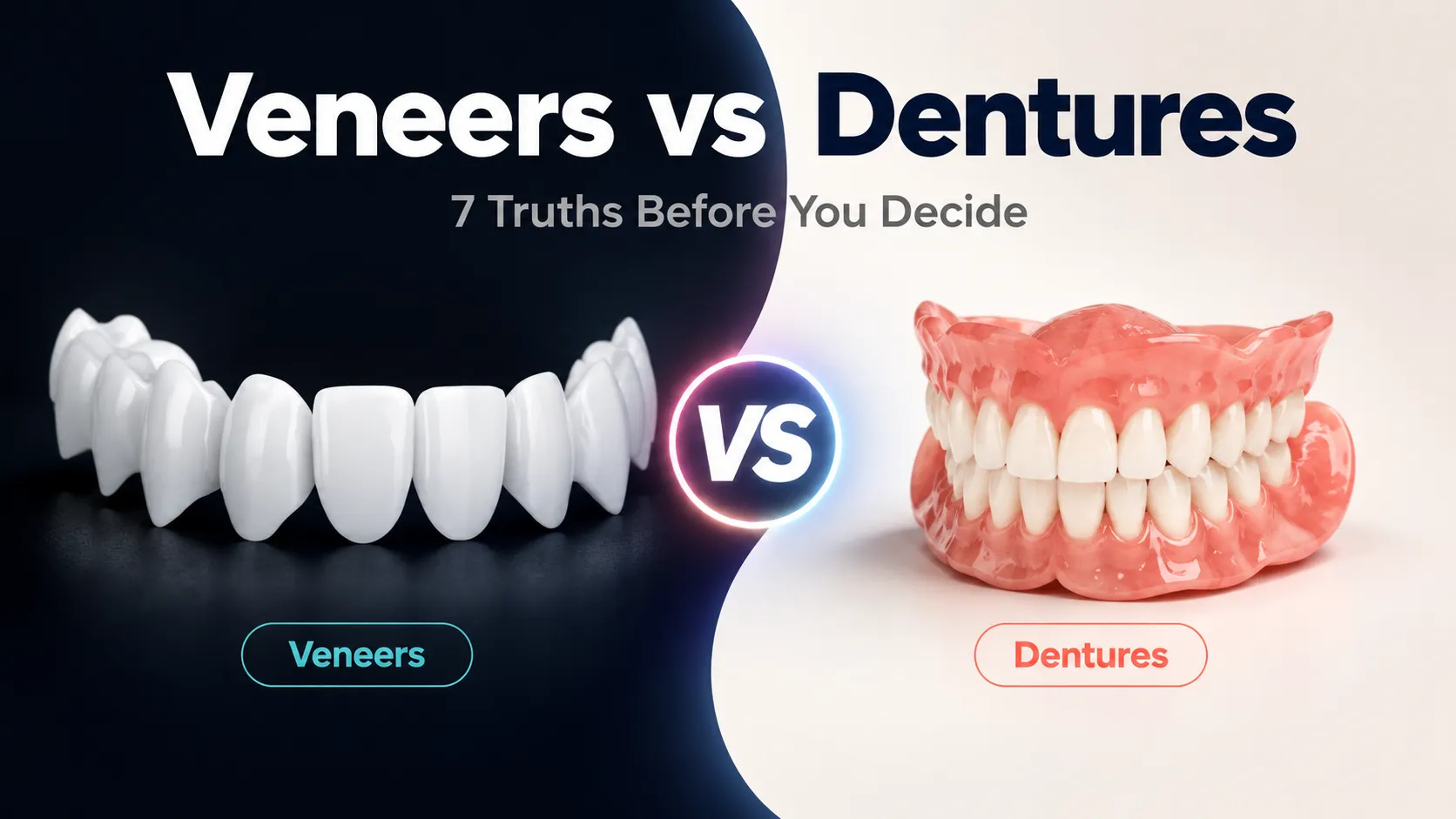
Veneers vs dentures is one of those searches people type at midnight, usually after biting into something they should not have. Both promise a better smile. Neither works the same way, and mixing them up can cost you thousands of dollars and a very awkward dentist conversation.
Here is the short version before we get into the details: veneers cover teeth you already have. Dentures replace teeth you no longer have. That one sentence solves half the confusion right there.
Table of Contents
The rest of this guide breaks down cost, comfort, durability, and which option actually fits your situation, so you can walk into your next dental appointment sounding like you already did your homework.
Veneers vs Dentures: Side-by-Side Comparison
Here is dentures vs veneers laid out plainly, feature by feature, so you can scan it in ten seconds.
| Feature | Veneers | Dentures |
| What it does | Covers existing teeth | Replaces missing teeth |
| Needs a natural tooth? | Yes, required | No, rests on gums |
| Removable? | No, permanently bonded | Yes, in most cases |
| Material | Porcelain or composite resin | Acrylic, nylon, or resin |
| Reversible? | No, enamel is removed first | Yes, fully reversible |
| Typical lifespan | 10 to 15 years | 7 to 10 years |
Notice the pattern. Every single row comes back to the same root difference: one option works with your existing teeth, and the other works without them.
What’s the Difference Between Veneers and Dentures?
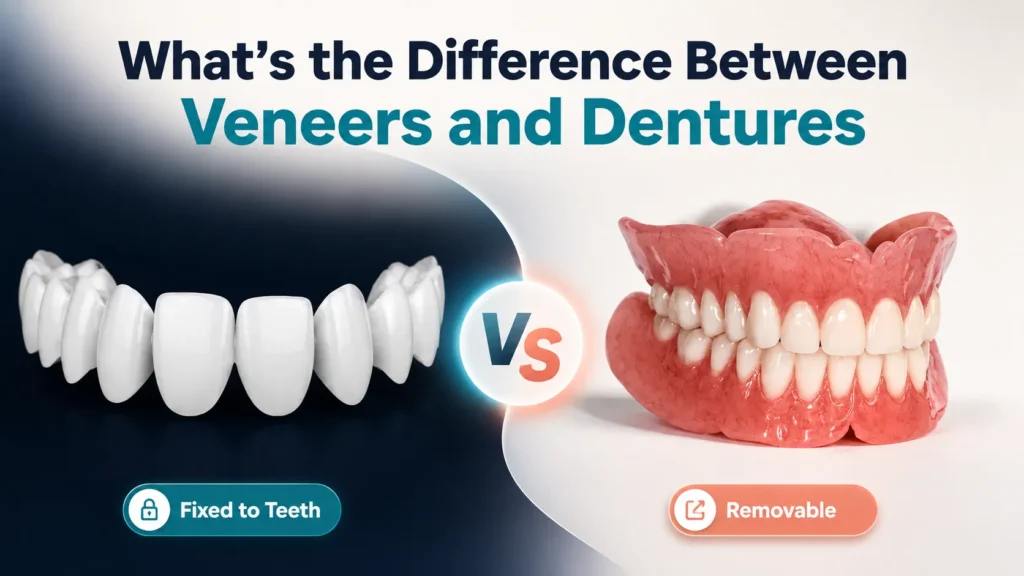
According to the American Dental Association, veneers are custom-made, tooth-colored shells bonded to the front surface of existing teeth to fix chips, stains, gaps, or misshapen teeth. They are cosmetic, and they need a healthy natural tooth underneath to bond to.
Dentures work the opposite way. Per the Cleveland Clinic, dentures are removable oral appliances that replace missing teeth, whether that is a full arch or just a few gaps. They rest on the gums, or in some cases attach to implants, rather than bonding to a remaining tooth.
So when people ask about veneers vs dentures, they are really asking two different questions. Do I want to improve teeth I still have, or do I need to replace teeth that are already gone? Your mouth usually answers that question for you.
Dentures vs Veneers vs Implants: Where Do Implants Fit?
A dental implant is a titanium post placed in the jawbone that fuses with the bone and supports a crown. Implants sit in a category of their own, and comparing dentures vs veneers vs implants usually comes down to three questions: how many teeth are missing, how much you want to spend, and how invasive a procedure you are willing to accept.
- Veneers: best when your teeth are structurally fine but look chipped, stained, gapped, or uneven.
- Dentures: best when several or all teeth are missing and you want a removable, budget-friendly fix.
- Implants: best when you want a fixed, non-removable replacement that behaves like a real tooth root, at a higher upfront cost.
Some patients end up using all three at different points in one treatment plan. That is not overkill. That is just how modern cosmetic and restorative dentistry actually works.
Veneers vs Dentures Cost: What You’ll Actually Pay
Money talks, so let’s talk money. Veneers vs dentures cost is usually the deciding factor for most people, more than looks or comfort.
Porcelain veneers typically run $900 to $2,500 per tooth, while composite veneers cost less, usually $250 to $1,500 per tooth. A full cosmetic set covering 6 to 8 visible teeth commonly totals somewhere between $9,000 and $20,000, according to multiple published 2026 dental-cost surveys.
Dentures cost less to start. Basic full dentures run roughly $450 to $1,500 per arch, standard dentures land around $1,500 to $2,500 per arch, and premium custom dentures can reach $2,000 to $3,600 per arch or more. A full upper-and-lower set roughly doubles those numbers.
So on pure sticker price, dentures usually win. But veneers are permanent and cosmetic, while dentures are removable and functional, so this is genuinely an apples-to-oranges comparison dressed up as a price war.
Financing changes the math too. Many dental offices offer in-house payment plans for veneers, and denture costs can sometimes be softened by Medicaid or discount dental plans depending on your state. Always ask for an itemized quote before comparing two offices, since a low headline price can hide extra fees for extractions, fittings, or follow-up visits.
Pros and Cons of Veneers
| Veneers Pros | Veneers Cons |
|---|---|
| Minimal alteration to the rest of your natural tooth structure. | The process is irreversible since a thin layer of enamel is removed. |
| Permanent, natural-looking result that does not come in and out. | Cost adds up fast, and insurance rarely covers cosmetic treatment. |
| Care routine matches your normal brushing and flossing habits. | A damaged veneer usually needs full replacement, not a quick repair. |
| Can last 10 to 15 years with proper maintenance. | Cavities can still form underneath the veneer if hygiene slips. |
Pros and Cons of Dentures
| Dentures Pros | Dentures Cons |
|---|---|
| One of the most affordable ways to replace multiple or all missing teeth. | Takes real adjustment time before eating and speaking feel normal again. |
| Removable, which makes cleaning and sleeping without them simple. | Requires nightly cleaning and periodic professional refitting. |
| Restores chewing ability and facial support that missing teeth take away. | Can shift or loosen as the jawbone changes shape over the years. |
| Available in full, partial, and implant-supported versions to fit your budget. | Certain sticky or hard foods become difficult or off-limits. |
Pop On Veneers vs Dentures: A Different Kind of Comparison
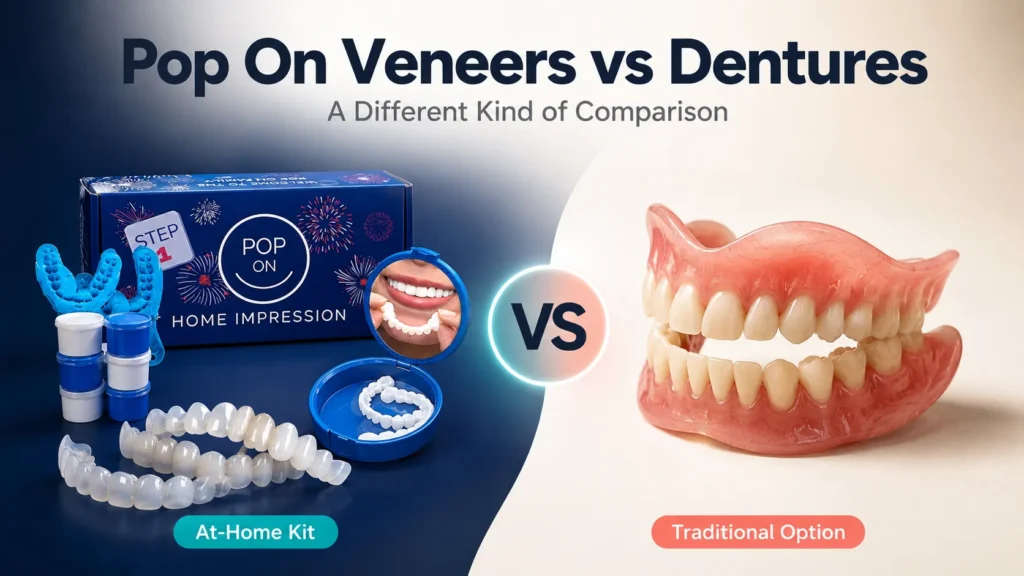
Here is where things get interesting. Pop on veneers vs dentures is not really a fair fight, because snap-on veneers sit in a lane of their own: cosmetic, removable, and non-surgical, but not a functional tooth replacement the way dentures are.
Removable, custom-fit veneers snap over your existing teeth, or over a denture base in some cases, without drilling, cement, or a dental chair involved. They will not fix a missing-tooth problem on their own, but they solve the appearance side of things fast and affordably.
A few established names worth comparing if that sounds like your situation:
- Shiny Smile Veneers – custom, removable snap-on veneers made from an impression of your own teeth.
- Pop On Veneers – a similar mail-in impression system built for a fast cosmetic upgrade.
- instasmile – a long-running clip-on veneer brand also used to visually cover gaps from missing teeth.
For a closer look, check our Shiny Smile Veneers legitimacy check, the full Pop On Veneers review, and our Instasmile veneers review for pricing, comfort, and fit details side by side.
If your goal is simply looking better in photos without surgery or a long treatment plan, this category often beats both traditional veneers and dentures on speed and price. If you are missing most of your teeth and need real chewing function back, dentures or implants still do the heavy lifting.
Can Veneers and Dentures Be Combined?
Yes, though not on the same tooth. A common approach: dentures or implant-supported dentures replace the missing teeth, then veneers go on any remaining natural teeth so the color and shape of everything matches. This combination shows up constantly in full smile makeovers, especially when only part of the mouth is missing teeth.
Is It Better to Get Veneers or Dentures?
Neither option is universally better. It depends entirely on what your mouth actually needs.
- Choose veneers if your teeth are healthy but you want to fix color, shape, or minor gaps.
- Choose dentures if you are missing several teeth or an entire arch and want a removable, cost-effective fix.
- Choose implants if you want a fixed, long-term replacement and are ready for the higher cost and healing time.
Asking whether veneers or dentures win in general is a bit like asking whether a raincoat beats an umbrella. It depends entirely on the weather you are actually dealing with.
The Honest Bottom Line
Veneers vs dentures does not have a single winner, and any dentist who gives you a one-size-fits-all answer without examining your mouth is skipping a step. Veneers polish what is already there. Dentures rebuild what is gone. Most people need one, the other, or eventually both at different stages of life.
If you already have your teeth and just want them to look sharper, start with a cosmetic dentist and look into veneers or a snap-on option like Shiny Smile Veneers, Pop On Veneers, or instasmile. If you are missing multiple teeth, book a consultation about dentures or implants first, since function has to come before polish.
Frequently Asked Questions
Is it better to have veneers or dentures?
It depends on your teeth. Veneers suit healthy teeth needing a cosmetic fix. Dentures suit missing teeth needing full replacement and restored chewing function.
What is the cheapest way to replace all your teeth?
Basic full dentures are typically the most affordable option, often starting around $450 to $1,500 per arch, well below implants or a full veneer set.
Why do dentists advise against veneers?
Dentists may advise against veneers if teeth have decay, weak enamel, or gum disease, since the procedure is irreversible and needs a solid, healthy foundation first.
What’s the average cost of a full set of veneers?
A full cosmetic set covering 6 to 8 visible teeth typically costs $9,000 to $20,000 for porcelain, depending on material, location, and dentist experience.
What is the main difference between veneers and dentures?
Veneers cover and enhance existing teeth. Dentures replace missing teeth entirely. One needs a tooth to bond to, the other does not.
Is it better to get veneers or dentures?
Neither is universally better. Veneers fit cosmetic concerns on healthy teeth, while dentures fit situations involving several or all missing teeth.
Can you get veneers if you have missing teeth?
Sometimes. Veneers can go on healthy teeth surrounding a gap, but they cannot replace the missing tooth itself, that requires an implant, bridge, or denture.
How much do veneers cost compared to dentures?
Veneers usually cost more overall, running $250 to $2,500 per tooth, while basic dentures start lower, around $450 to $1,500 per arch.
Are dentures removable, and are veneers permanent?
Yes. Dentures are designed to come in and out for cleaning and sleeping. Veneers are bonded permanently and are not meant to be removed.
How long do veneers last compared to dentures?
Veneers typically last 10 to 15 years with good care. Dentures usually last 7 to 10 years before needing replacement or relining.
Can veneers and dentures be combined in the same treatment plan?
Yes. Dentures or implants replace missing teeth, while veneers are placed on remaining natural teeth so the whole smile matches in color and shape.
What’s the difference between veneers, dentures, and implants?
Veneers cover existing teeth cosmetically. Dentures are removable replacements for missing teeth. Implants are fixed, surgically placed replacements anchored in the jawbone.
Do dentures or veneers require more maintenance?
Dentures generally need more upkeep, including nightly cleaning, soaking, and periodic refitting. Veneers just need normal brushing and flossing.
Which option is better for someone with extensive tooth loss, veneers or dentures?
Dentures, without question. Veneers require a healthy tooth to bond to, so extensive tooth loss calls for dentures or implants instead.
This article contains affiliate links. If you purchase through our links, we may earn a commission at no extra cost to you. We only recommend products we genuinely believe in. Read our Affiliate Disclaimer for full details.