



A useful veneer estimate should include more than the advertised per-tooth price. Consultations, X-rays, temporary veneers, gum treatment, replacement retainers, repairs, sedation, and future replacements may affect the total. Ask each provider for a written treatment plan showing what is included, which material will be used, and how complications or remakes are handled.
Table of Contents
How Much Does It Cost to Get Veneers – pricing by material, quantity, and location, using data reported by CareCredit and Delta Dental. Whether you need one chipped tooth fixed or a full smile makeover, the cost of veneers depends on choices you control: material, how many teeth you treat, and where you live. Let’s get into the numbers.
One quick note before the numbers: every figure here reflects national averages and reported ranges, not a personal quote. Your actual veneers price will depend on your dentist’s fee schedule, your exact zip code, and the condition of your teeth going in. Treat this guide as a benchmark for comparing quotes, not a substitute for an in-person consultation.
What Are Veneers, and Why Does the Price Vary So Much?
According to the American Dental Association’s MouthHealthy resource, veneers are custom-made, tooth-colored shells bonded to the front surface of a tooth to fix chips, stains, gaps, or misshapen teeth. They differ from crowns, which cover the entire tooth rather than just the front surface. Because a dentist customizes every veneer to your mouth, dental veneers cost is never a flat number.
The price of veneers also depends on whether the process is reversible. Porcelain veneers usually require removing a thin layer of enamel, which is permanent, while some no-prep options preserve more of the natural tooth. That difference in technique is part of what separates a $500 composite veneer from a $2,800 porcelain one.
Veneers Cost Per Tooth: The National Averages
A national provider pricing study, reported by CareCredit, puts the average cost of one veneer at $1,765 for porcelain, with a typical range of $500 to $2,895. That range explains why two people can get “the same” procedure and pay wildly different amounts.
Porcelain veneers cost
Cost of porcelain veneers per tooth averages $1,765 nationally. Porcelain remains the most popular choice because it resists stains well and mimics natural enamel, which is part of why porcelain veneers cost more than composite alternatives.
Composite veneers cost
Composite veneers price runs lower. Lab-manufactured composite veneers average $1,373 per tooth (range $800 to $1,950), while composite veneers made chairside, directly in the dentist’s office, average $872 per tooth (range $500 to $1,250). Composite veneers cost less partly because they use less material and skip separate lab fees.
Porcelain laminate (no-prep) veneers
Porcelain laminate veneers, the ultra-thin no-prep style, average $1,817 per tooth (range $975 to $2,650). Delta Dental’s 2024 internal data lands in a similar zone, estimating $1,180 to $2,185 per tooth for this style without insurance.
Below is a quick side-by-side of average veneers cost by type, based on the sources above.
| Veneer type | Average cost | Low end | High end |
| Composite (dental office) | $872 | $500 | $1,250 |
| Composite (lab-manufactured) | $1,373 | $800 | $1,950 |
| Porcelain | $1,765 | $500 | $2,895 |
| Porcelain laminate (no-prep) | $1,817 | $975 | $2,650 |
| Full set, porcelain (6-8 teeth) | $15,486 | $5,700 | $24,500 |
Cost of a Full Set: 6, 8, or 10 Veneers
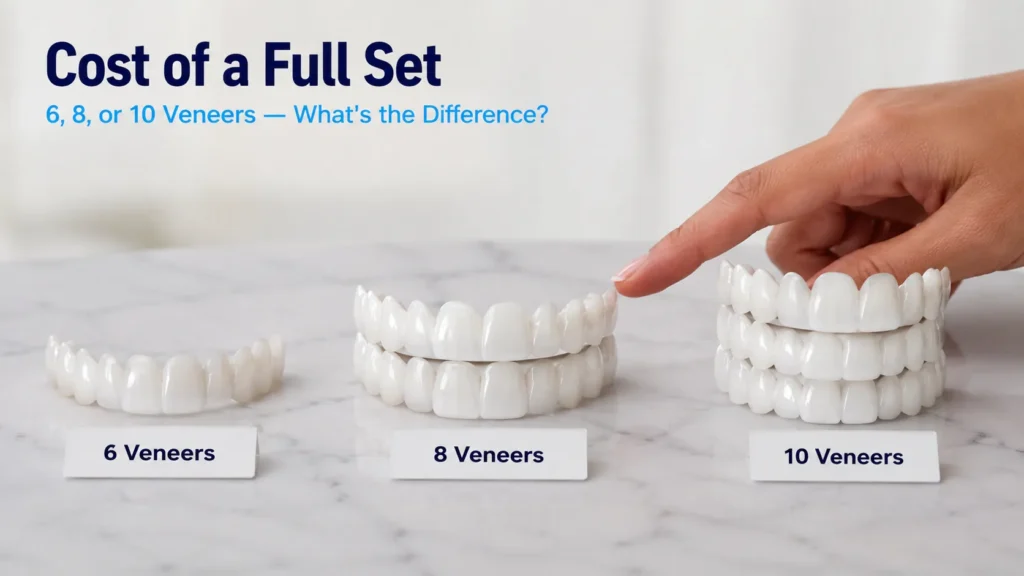
Most smile makeovers do not stop at one tooth. A full set of porcelain veneers, typically six to eight teeth, averages $15,486 nationally, with a range of $5,700 to $24,500. That figure already reflects the per-tooth discount many dentists apply to multi-tooth cases.
Using the per-tooth national average as a baseline, here is roughly what different quantities tend to cost:
- Cost of 6 veneers: about $10,600 on average, ranging from roughly $3,000 to $17,400
- Cost of 8 veneers: about $14,100 on average, close to the reported full-set figure of $15,486
- Cost of 10 veneers: about $17,700 on average, ranging from roughly $5,000 to $29,000
These are estimates built from national averages, not fixed quotes, so treat them as a starting point for budgeting rather than a guarantee. Cost of veneers for front teeth only, usually four to six teeth in the visible “smile zone,” tends to land toward the lower end of these ranges since fewer teeth need treatment.
Average Cost of Veneers by State
Average cost of veneers by state varies more than you might expect. State-level data from CareCredit shows average per-veneer pricing from around $1,242 in Maine to over $2,300 in states like Idaho and Vermont. A sample comparison:
| State | Avg. cost/veneer | State | Avg. cost/veneer |
| Maine | $1,242 | California | $1,663 |
| North Carolina | $1,435 | New York | $1,503 |
| Texas | $1,954 | Florida | $1,854 |
| Idaho | $2,315 | Vermont | $2,359 |
| Washington, D.C. | $2,170 | Ohio | $1,766 |
Larger metro areas and states with a higher cost of living, including California, New York, and Washington, D.C., tend to sit above the national average, while several Midwestern and Southern states run closer to or below it. If you are comparing veneers cost near me against these numbers, remember that urban dentists with heavy cosmetic caseloads often charge more than general dentists in smaller towns, even within the same state.
What Affects Your Veneers Price
- Material: porcelain, composite, or porcelain laminate
- Number of teeth treated
- Dentist’s experience and reputation, especially for cosmetic specialists
- Geographic location and local cost of living
- Lab fees for custom-made porcelain veneers
- Whether the case includes other procedures, like whitening or minor orthodontics
Hidden and Long-Term Costs to Budget For

The headline veneers cost figures above cover the veneers themselves, but a few related expenses often catch people off guard. Planning for these upfront makes the final bill far less surprising.
- Consultation and imaging: initial exams, X-rays, and digital scans are usually billed separately from the veneers cost quoted for the procedure itself.
- Temporary veneers: if your porcelain veneers take a few weeks to arrive from the lab, you may pay a small additional fee for temporaries in the meantime.
- Prep work: treating cavities or gum disease before veneers, since a dentist will not place veneers over unhealthy teeth, adds its own cost.
- Repairs and replacement: composite veneers typically last five to seven years and porcelain around fifteen, so budgeting for eventual replacement is part of the real long-term cost of veneers.
None of these extras are usually included in the per-tooth price of veneers you see quoted online, so ask your dentist for an itemized estimate before you commit.
Veneers Cost vs Other Smile Options
Veneers cost vs crowns
Dental crowns generally run between $1,000 and $3,500 per tooth depending on material, a range that overlaps significantly with veneers cost. Crowns cover the entire tooth and suit teeth with structural damage, while veneers only cover the front surface and work best as a cosmetic fix on otherwise healthy teeth.
Veneers cost vs Invisalign
Full Invisalign treatment commonly costs $3,000 to $8,000 total, not per tooth. If your main issue is crooked or misaligned teeth rather than color or shape, a veneers cost vs Invisalign comparison often favors Invisalign as the more targeted, and sometimes cheaper, fix.
Veneers cost vs implants
A single dental implant typically costs $3,000 to $6,000 per tooth, often more once you add the crown. Implants replace a missing tooth entirely, while veneers only work on teeth you still have. They solve different problems, so the cheaper option depends on what you actually need.
Cheapest Veneers Cost: Ways to Save

If the cost of veneers feels out of reach, a few practical options exist before ruling out a smile upgrade entirely.
Snap-on and pop-on veneers
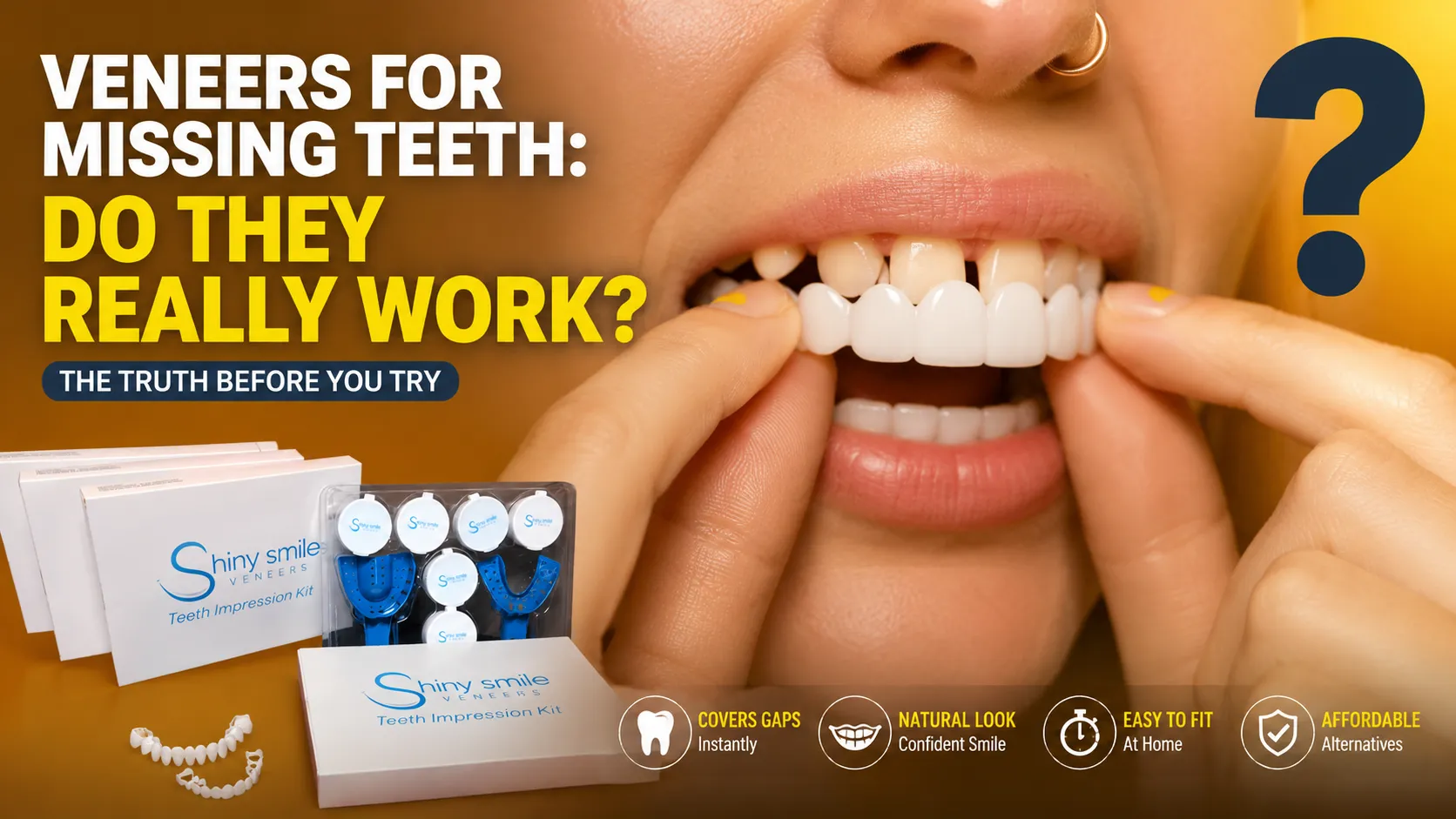
Removable, dentist-free alternatives like Shiny Smile, Pop-on Veneers, and Insta Smile offer a fraction of the price of permanent veneers, often a few hundred dollars for a full arch. They clip over your existing teeth without any drilling, which makes them reversible and far cheaper than lab-fabricated porcelain. They are not a permanent fix or a substitute for dental treatment, but they can work well for events, budgeting time before a bigger investment, or simply trying out a brighter smile.
Our breakdown of snap-on veneer brands compares fit, durability, and price across the major names, including Shiny Smile, Pop-on Veneers, and Insta Smile.
Financing and payment plans
Many dental offices offer in-house payment plans, and third-party financing through services like CareCredit can spread the cost of veneers over months instead of paying it all upfront. We cover the pros and cons of each option in our guide to veneers financing.
Dental schools and shopping around
University dental schools often provide veneers at a discount, since supervised students perform the work under licensed faculty. Getting two or three consultations before committing can also reveal a surprisingly wide spread in quotes for the exact same procedure.
Does Insurance Cover Veneers?
Typically, no. Both CareCredit and Delta Dental confirm that veneers are considered an elective cosmetic procedure, so standard dental insurance plans usually will not cover them unless a dentist documents medical necessity. Medicare and Medicaid generally exclude veneers as well, though some Medicare Advantage plans include limited cosmetic dental coverage.
It is still worth checking your specific plan and asking your dentist for a pre-treatment estimate. A Health Savings Account (HSA) or Flexible Spending Account (FSA) may cover part of the cost if a portion of the treatment is medically necessary, such as repairing a damaged tooth.
Choosing the Right Provider for Your Veneers Cost
Price should not be the only factor in your decision. The ADA has publicly warned about unlicensed “veneer technicians” offering services outside a licensed dental practice, which can lead to infection, nerve damage, or veneers placed over teeth with untreated decay. Always confirm your provider is a licensed dentist before booking, no matter how good the price of veneers looks.
Is Paying for Veneers Worth It?
Whether the price of veneers is worth paying comes down to what you are trying to fix and how long you want the result to last. For a single chipped or stained tooth, a lower-cost composite veneer or even bonding may solve the problem without a big financial commitment. For a broader smile makeover, porcelain’s longer lifespan, roughly fifteen years with proper care, can make the higher upfront veneers cost a better value over time than replacing cheaper composite veneers every five to seven years.
The right call also depends on your dental health. Veneers work best on teeth that are otherwise healthy, since the ADA notes that dentists need to resolve issues like decay or gum disease first. If you are unsure which route fits your budget and your teeth, a consultation with a licensed dentist, not a price calculator, is the best next step.
Frequently Asked Questions
How much do veneers cost with insurance?
Since standard dental insurance rarely covers cosmetic veneers, insured patients usually pay close to full price, roughly $500 to $2,895 per porcelain veneer, unless the dentist documents medical necessity for partial coverage.
How much do veneers cost without insurance?
Without insurance, a single porcelain veneer averages $1,765, while a full set of six to eight averages $15,486 nationally. Composite veneers cost less, averaging $872 to $1,373 per tooth.
Why are veneers so expensive?
Veneers require custom fabrication, often in a dental lab, plus a skilled dentist’s time for tooth preparation, fitting, and bonding. Porcelain especially demands precision, which raises both material and labor costs.
What is the 4-8-10 rule for veneers?
It is an informal cosmetic dentistry guideline: four veneers for minor smile touch-ups, eight for a fuller “smile zone” makeover, and ten to cover a broader arch, including premolars, for a more dramatic transformation.
Can insurance cover veneers?
Rarely. Insurers classify veneers as cosmetic, so coverage is uncommon. Some plans make exceptions when a veneer restores function after damage or decay, so it is worth requesting a pre-treatment estimate.
How long do full veneers last?
Composite veneers typically last five to seven years, while porcelain veneers can last around fifteen years with proper care, according to CareCredit’s guidance. Chips, stains, or gum changes may shorten that lifespan.
What is a cheaper option than veneers?
Teeth whitening, dental bonding, or removable snap-on veneers from brands like Shiny Smile or Pop-on Veneers all cost significantly less than permanent veneers, though they address a narrower range of cosmetic issues.
What disqualifies you for veneers?
Untreated gum disease, extensive tooth decay, insufficient enamel, severe teeth grinding, or a deep overbite can disqualify candidates until those issues are resolved, since veneers need healthy teeth for a stable bond.
Can I bite into an apple with veneers?
Dentists generally advise caution with hard or crunchy foods, including whole apples, since biting directly with your front teeth can chip or dislodge a veneer. Cutting hard foods into smaller pieces is safer.
The Bottom Line
The honest answer to how much does it cost to get veneers is: it depends on your material, your dentist, and where you live, but you now have real national and state-level numbers to work from instead of guesswork. Compare quotes, ask about financing, and confirm your provider’s license before you commit to a price of veneers that fits both your smile goals and your budget.
This article contains affiliate links. If you purchase through our links, we may earn a commission at no extra cost to you. We only recommend products we genuinely believe in. Read our Affiliate Disclaimer for full details.