
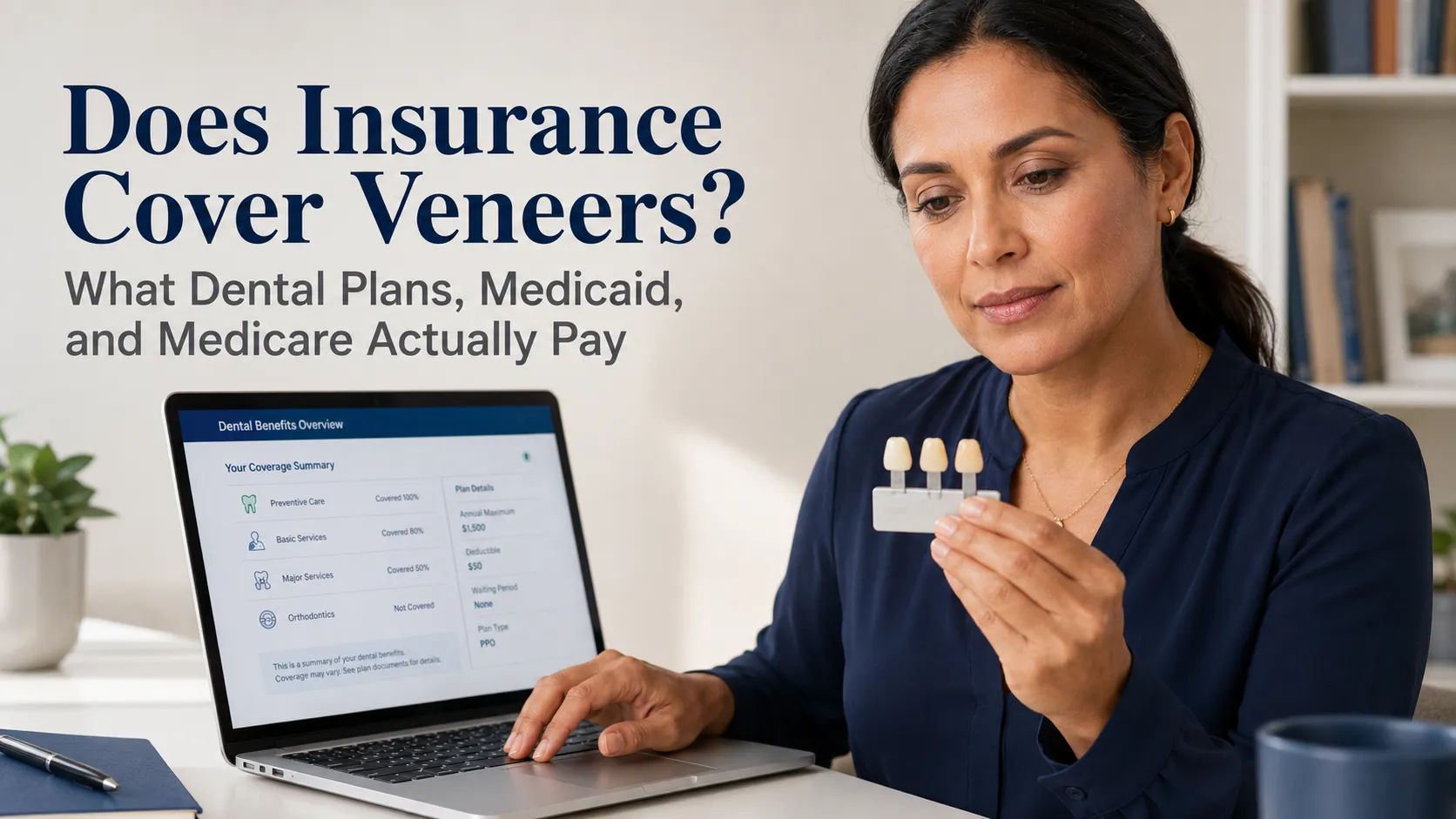
Dental insurance usually excludes veneers performed only to improve appearance. Limited coverage may be possible when treatment has a documented restorative purpose, but approval depends on the plan, clinical records, exclusions, and preauthorization requirements. Request a written predetermination from the insurer before treatment and confirm that an estimate is not the same as a guarantee of payment.
Table of Contents
This guide covers how dental insurance veneers coverage actually works, what Delta Dental, Medicare, and Medicaid say about it, and what your realistic options are if your plan says no. If you have not looked at pricing yet, our guide to how much veneers cost is worth reading first, since financing decisions usually start with a real number.
Coverage rules also are not uniform across insurers, so what your coworker’s plan paid for is not a reliable predictor of what yours will. Reading your plan’s cosmetic exclusion language, or calling to ask directly, remains the only way to get a real answer for your situation.
Does Insurance Cover Veneers? The Short Answer
Usually, no. Delta Dental confirms that veneers are commonly considered a cosmetic procedure, and most employer, family, or individual dental plans exclude cosmetic work. That said, some plans include exceptions, so double-checking your specific benefit details before you rule out insurance for veneers entirely is worth the phone call.
The reason comes down to how insurers define the procedure. Veneers insurance coverage depends heavily on whether your plan, and your dentist’s documentation, treats the case as cosmetic or restorative. That single distinction decides almost everything about whether you will get coverage.
Here is a quick-glance summary before we get into the details on each payer type.
| Payer | Typical coverage | Best chance of an exception |
| Private dental insurance (e.g. Delta Dental) | Usually excluded as cosmetic | Group plan with a documented restorative need |
| Original Medicare (Parts A & B) | Not covered | Dental service tied directly to a covered medical treatment |
| Medicare Advantage (Part C) | Usually excluded, varies by plan | Plans with enhanced dental riders |
| Medicaid | Not covered in most states | State-specific medically necessary exceptions |
Are Veneers Considered Cosmetic or Medical?
According to the American Dental Association’s MouthHealthy resource, veneers are thin shells bonded to the front of a tooth to improve its appearance, covering issues like chips, stains, or gaps. Because their primary purpose is aesthetic, most insurers classify them as cosmetic dentistry, not restorative treatment.
Restorative dental work, like a filling or a crown placed after decay, treats a functional problem. Cosmetic dentistry insurance coverage almost never extends to procedures whose main goal is appearance rather than function or pain relief. Veneers sit awkwardly in between, since they can address both, which is exactly why coverage rules feel so inconsistent from one plan to the next.
When Might Insurance Treat Veneers as Medically Necessary?
Coverage becomes more realistic when a veneer repairs or protects a tooth from further damage, rather than simply changing its color or shape. A veneer placed after a fracture, to protect an already-weakened tooth, has a better shot at partial coverage than one requested purely for whiter, more uniform front teeth.
Even then, approval is not guaranteed. Your dentist’s clinical notes and the specific plan language both matter. If you want to explore this route, ask your dentist to document the functional reason for the veneer clearly before submitting a claim, not after.
Does Delta Dental Cover Veneers?
Generally, no. Delta Dental’s own guidance states that veneers are often not covered by employer, family, or individual dental insurance plans since they are considered cosmetic. However, if you have group coverage through an employer or a program such as Medicaid, Delta Dental recommends speaking with your benefits administrator, since some group plans include exceptions.
Delta Dental also notes that porcelain laminate veneers without insurance average $1,180 to $2,185 per tooth, based on its 2024 internal data. That figure is a useful benchmark if you are budgeting on the assumption that insurance for veneers will not cover the bulk of the bill.
Does Medicare Cover Veneers?
No, not typically. According to Medical News Today’s summary of Medicare guidance, Medicare does not usually cover dental veneers because it considers them cosmetic rather than medically necessary. Original Medicare (Parts A and B) generally excludes routine dental care altogether.
- Medicare may help in rare cases where a dentist uses a veneer to repair or protect a damaged tooth from further harm.
- Medicare Advantage (Part C) plans sometimes offer broader dental benefits than Original Medicare, so it is worth checking your specific plan.
- Routine cleanings, fillings, extractions, and dentures are also excluded from Original Medicare, so veneers are not an outlier here.
Does Medicaid Cover Veneers?
Almost always, no. Medicaid dental benefits focus on medically necessary care, like treating infection, pain, or damaged teeth, and cosmetic procedures such as veneers typically fall outside that scope. Adult Medicaid dental benefits also vary significantly by state, with some states offering only emergency dental coverage for adults and others offering more comprehensive benefits.
Children enrolled in Medicaid generally have access to broader dental coverage through required early and periodic screening benefits, but that does not usually extend to cosmetic veneers either. If you are researching a specific state’s Medicaid dental rules, your state Medicaid office’s dental benefits page is the most reliable source, since program details change and vary by state.
A note on reimbursement rates: even in the rare case where a state Medicaid program approves a restorative veneer, the payout is typically far below a dentist’s standard fee. That is part of why some dentists limit how many Medicaid patients they can accept for more complex procedures, veneers included.
Common Reasons Veneer Insurance Claims Get Denied

- The claim lists a purely cosmetic reason, such as tooth color or shape, with no functional justification documented.
- The plan has a cosmetic exclusion clause that applies regardless of the CDT code submitted.
- The patient has not met a waiting period required for major restorative work under a newer policy.
- The claim exceeds an annual maximum benefit, even if the procedure itself would otherwise qualify.
Understanding these patterns before you submit a claim, or before your dentist does, can save weeks of back-and-forth. If your claim is denied for one of these reasons, ask your dentist’s office whether an appeal with additional documentation is worth pursuing for your specific case.
What Insurance Codes Do Dentists Use for Veneers?
Dentists bill veneers using specific CDT (Current Dental Terminology) codes, which insurers use to determine how, or whether, a claim gets paid. Knowing these insurance codes for veneers can help you understand an Explanation of Benefits (EOB) if your claim gets denied or only partially reimbursed.
| Code | Veneer type | What it means for coverage |
| D2960 | Resin veneer, chairside | Sometimes classified as basic restorative, occasionally better covered |
| D2961 | Resin veneer, lab-fabricated | Usually classified as major restorative with higher patient cost share |
| D2962 | Porcelain veneer, lab-fabricated | Usually classified as major restorative or cosmetic, most often excluded |
Even when a plan technically allows one of these codes, many insurers apply what’s called an alternate benefit provision, paying the claim at the rate of a cheaper procedure, like a basic filling, and leaving you responsible for the difference. Ask your dentist’s billing team to walk you through how your specific plan tends to handle these codes.
How to Get Veneers Covered by Insurance (or Get Closer to It)
- Ask your dentist to document any functional reason for the veneer, such as a fracture or structural weakness, not just the cosmetic goal.
- Request a pre-treatment estimate from your insurer before scheduling, so you know your out-of-pocket cost in advance.
- Check whether your plan has a waiting period or annual maximum that affects how much it will pay even if the claim is approved.
- If a claim is denied, ask for the specific reason in writing, then have your dentist submit a written appeal with supporting clinical notes.
None of these steps guarantee that your plan will pay for a cosmetic veneer, but they meaningfully improve your odds if there is a genuine restorative case to be made.
Questions to ask your insurer before you book
- Does my plan have a specific cosmetic dentistry exclusion, and does it apply to all veneer types or only some?
- Is there a waiting period for major restorative procedures, and have I already met it?
- What is my annual maximum benefit, and how much of it have I already used this year?
- Which CDT codes does my plan cover at a basic restorative rate versus a major restorative or cosmetic rate?
Getting these answers in writing, not just verbally from a call center representative, gives you something concrete to reference if a claim later gets denied unexpectedly.
Veneers Payment Plans and Financing Options

If insurance is not going to cover the bulk of the cost, and for most people it will not, a few realistic financing paths can still make veneers affordable.
CareCredit for veneers
CareCredit is a healthcare credit card accepted by many cosmetic dental practices, letting you spread veneers payment plans over several months instead of paying the full amount upfront. Terms and promotional financing periods vary, so review the interest rate carefully before signing, especially once any promotional period ends.
In-house dental office payment plans
Many cosmetic dentists offer their own veneers payment plans directly, sometimes interest-free over a shorter term. This is worth asking about during your consultation, since in-house plans can be more flexible than third-party financing for smaller balances.
HSA and FSA for veneers
An HSA for veneers or FSA eligible veneers claim depends on medical necessity. If a portion of your treatment is restorative rather than purely cosmetic, that portion may qualify for reimbursement through a Health Savings Account or Flexible Spending Account. Purely cosmetic veneers generally do not qualify, so confirm eligibility with your plan administrator before assuming those funds will apply.
Affordable snap-on alternatives
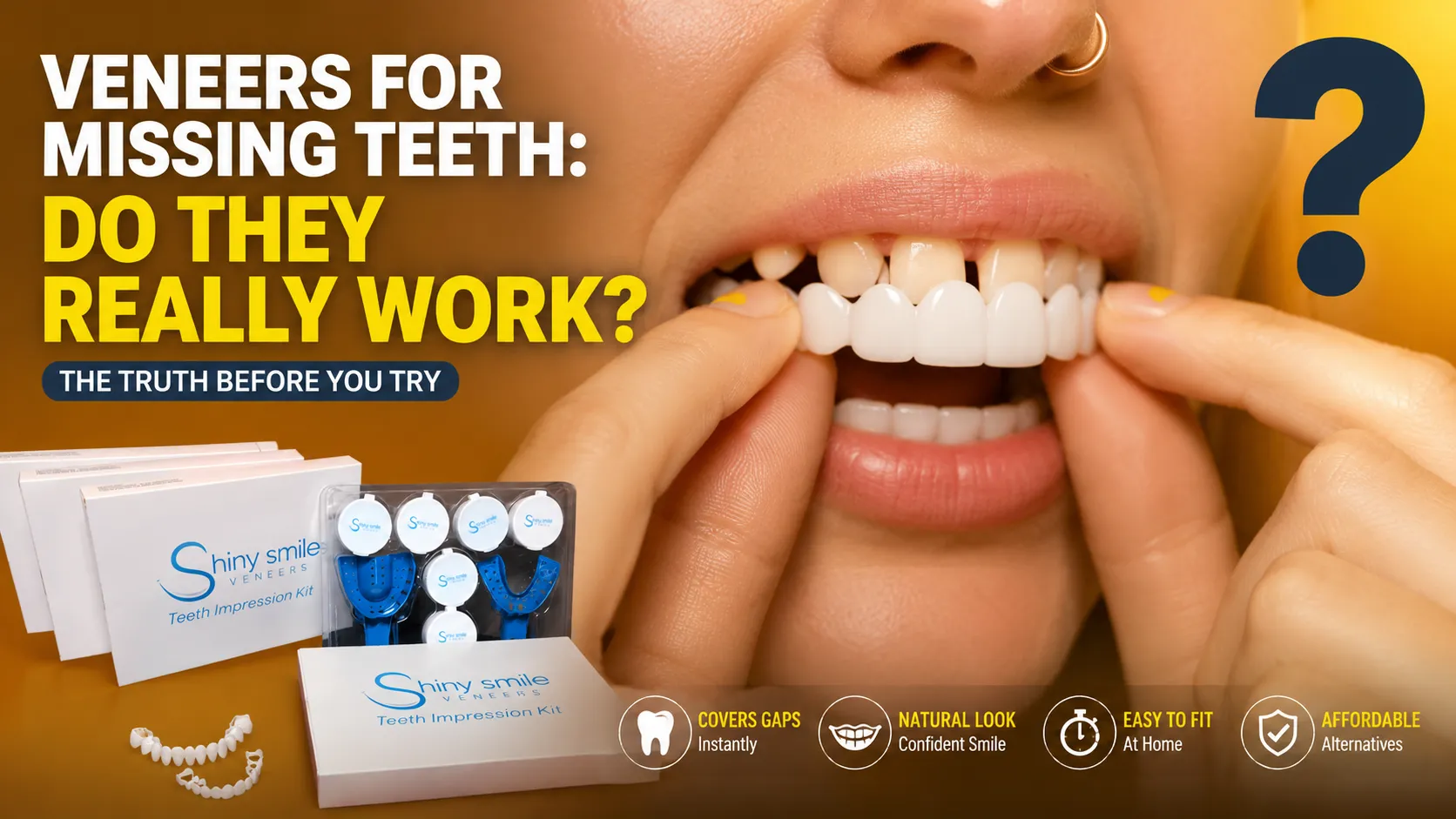
If insurance for veneers is not an option and financing still feels like a stretch, removable alternatives from brands like Shiny Smile, Pop-on Veneers, and Insta Smile cost a fraction of permanent porcelain veneers. They will not replace dentist-fitted veneers long term, but they are a reasonable bridge while you save or explore financing. Our review of snap-on veneer brands compares pricing and fit across the major options.
Cosmetic Dentistry Insurance Coverage: Are There Add-On Plans?
A small number of insurers and discount dental plans market themselves as covering cosmetic dentistry, including veneers, usually through a separate rider or membership rather than a standard dental plan. These plans vary widely in what they actually pay toward veneers, and many function more like discount networks than true insurance. Read the fine print carefully, since dental insurance that covers cosmetic veneers outright is genuinely rare rather than a standard offering you can expect to find easily.
Frequently Asked Questions
Does dental insurance ever cover veneers?
Rarely, and only in limited cases. Most dental plans classify veneers as cosmetic and exclude them, though some plans make exceptions when a veneer repairs or protects a damaged tooth rather than just improving its appearance.
Does Medicaid cover veneers?
Almost never. Medicaid dental benefits focus on medically necessary care, and cosmetic procedures like veneers typically fall outside that scope. Adult dental benefits also vary by state, so check your specific state Medicaid program for details.
Does Delta Dental cover veneers?
Generally no, since Delta Dental classifies veneers as cosmetic. Some group plans through an employer or program may include exceptions, so Delta Dental recommends checking with your benefits administrator before assuming you have no coverage.
Can you use an HSA or FSA for veneers?
Only the portion of treatment considered medically necessary typically qualifies. Purely cosmetic veneers usually are not FSA eligible or HSA eligible, so confirm with your plan administrator before counting on those funds.
What’s the difference between cosmetic and restorative veneers for insurance purposes?
Restorative veneers repair or protect a damaged tooth and have a better chance at partial coverage. Cosmetic veneers primarily improve appearance, like color or shape, and insurers almost always exclude them from coverage.
What insurance code do dentists use for veneers?
Dentists typically use CDT codes D2960 (chairside resin), D2961 (lab-fabricated resin), or D2962 (lab-fabricated porcelain). Insurers use these codes to decide classification and reimbursement, though coverage still depends on your specific plan.
What financing options exist if insurance won’t cover veneers?
Common options include CareCredit, in-house dental office payment plans, and, for a lower-cost alternative, removable snap-on veneers from brands like Shiny Smile or Pop-on Veneers while you save for permanent treatment.
Are there any circumstances where insurance treats veneers as medically necessary?
Yes, when a veneer repairs or protects a fractured or structurally weakened tooth rather than simply changing its color or shape. Approval still depends on your dentist’s documentation and your specific plan’s language.
The Bottom Line
The honest answer to does insurance cover veneers is that most standard dental plans, Medicare, and Medicaid will not, since they classify veneers as cosmetic rather than medically necessary. Genuine coverage is the exception, not the rule, and it usually requires a documented restorative reason. Budgeting for veneers payment plans or financing from the start will save you a frustrating surprise after your consultation.
This article contains affiliate links. If you purchase through our links, we may earn a commission at no extra cost to you. We only recommend products we genuinely believe in. Read our Affiliate Disclaimer for full details.